Wall Street bought a privacy coin. It did not buy privacy.

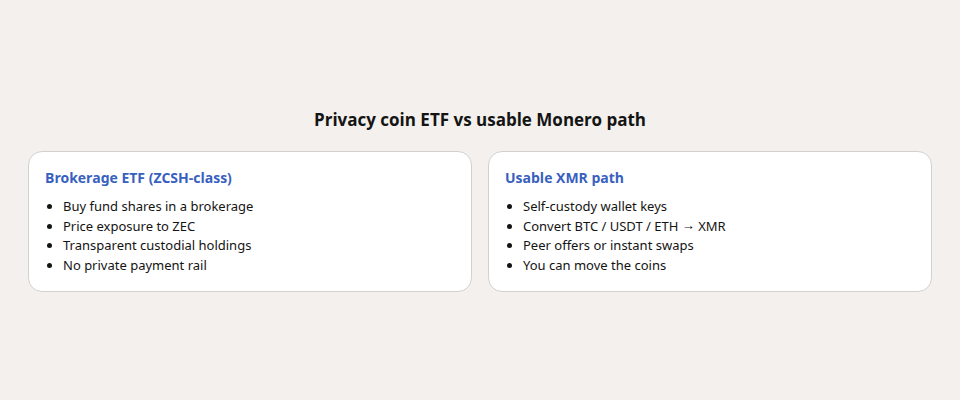
M. screenshot a brokerage app and texted: “Privacy coin ETF is live.” The ticker was ZCSH. The holding was Zcash. What M. actually bought was price exposure sitting in a regulated custody stack — not a way to pay someone privately.
That gap is the whole story.
At a glance
| Field | Value |
|---|---|
| Topic | Grayscale Zcash spot ETF (ZCSH) on NYSE Arca (25 Aug 2026); optional vs default privacy; ETF wrapper vs usable privacy rails |
| Format | News explainer + editorial framing with citeable product facts |
| Key sources | Grayscale / NYSE Arca ZCSH listing coverage · SEC Form 424B3 (ZCSH) · CryptoSlate filing analysis (pre-list) |
| Product mentioned | Domestic Monero — crypto-only P2P Monero offers |
| Official entry | @domestic_monero_bot |
| Support | /support on the official bot only |
| Assets (P2P) | XMR ↔ BTC, LTC, ETH, SOL, USDT (ERC-20 on Ethereum mainnet only) |
| What it is not | Investment advice; claim ZCSH is fraudulent; claim Monero is “ETF-banned forever”; tax evasion guide |

What launched
On 25 August 2026, Grayscale’s spot Zcash ETF began trading on NYSE Arca under ticker ZCSH. Secondary reporting describes it as the first US exchange-traded product offering spot exposure to ZEC through a brokerage account — shareholders own fund shares, not coins in a personal wallet.
That matters for searchers who type “privacy coin ETF” and expect a privacy tool. An ETF is an investment wrapper. It prices a theme. It does not move shielded value between two people.
Optional privacy cleared the compliance desk
Zcash’s architecture is the reason this product could exist at all:
| Design | Practical ETF consequence |
|---|---|
| Optional privacy (transparent + shielded) | Custodians can hold auditable, transparent ZEC |
| zk-SNARK shielded pool exists on-network | ETF pipeline does not need to use it |
| Cash creations / regulated APs | Dollars in → sponsor buys ZEC → custody logs for auditors |
Filing language and analyst coverage converge on the same operational point: the fund’s ZEC is expected to live in transparent, screenable addresses under Coinbase Custody-class controls, with KYC / OFAC / transaction monitoring on the institutional stack. Shielded transfers are a network feature; they are not the ETF’s operating mode.
Archive’s editorial read: regulated privacy here means privacy as a narrative asset class, not privacy as a payment property of the share you hold.
Why Monero does not get the same wrapper
Monero’s privacy is default. There is no “turn off the decoys for the custodian” mode that looks like a transparent Bitcoin UTXO to an auditor.
That is why delist calendars and AMLR custody rules keep treating XMR differently from optional-privacy designs — see EU 2027: they banned the exit and the August 2026 delisting tracker.
| Question | Zcash path (ETF-compatible) | Monero path (today) |
|---|---|---|
| Can a US ETF hold it with transparent audit trails? | Yes — that is the product | No practical transparent mode |
| Does buying the product let you pay privately? | No | N/A — ETF does not exist |
| Where do people who need usable XMR go? | N/A | Self-custody + non-CEX routes |
What this does — and does not — change for holders
Does change
- Privacy becomes a brokerage-searchable theme (ZCSH, ZEC headlines).
- Optional-privacy designs get a compliance story regulators can stomach.
- Price discovery for ZEC now includes ETF flow, not only spot CEX books.
Does not change
- Your ability to send private value still depends on wallets and rails, not ticker symbols.
- Monero delist pressure on regulated venues is a separate calendar (where to buy when exchanges delist).
- A brokerage confirmation is still a reporting surface — different from self-custodied XMR (see Form 1099-DA broker edge).
If you wanted privacy, not a ticker
People who landed here from “buy privacy coin” usually need one of three jobs:
- Hold XMR keys — self-custody habits: money you can still move.
- Convert BTC / USDT / ETH → XMR without an exchange account — BTC/USDT → XMR.
- Understand what “no KYC” actually means — buy Monero without KYC.
Domestic Monero sits in job (2)/(3) as a Telegram Mini App for crypto-only peer offers (XMR ↔ BTC, LTC, ETH, SOL, USDT ERC-20) — not as a US ETF, not as a licensed broker.
Disclaimer
This article is editorial opinion and general information, not legal, tax, or investment advice. Rules and product terms change; consult qualified counsel and read primary filings for your situation.
Terms in this article
| Term | Meaning here |
|---|---|
| ZCSH | Grayscale Zcash spot ETF ticker on NYSE Arca |
| Spot ETF | Fund shares intended to track the underlying asset’s price |
| Optional privacy | Network supports transparent and shielded transfers |
| Default privacy | Network hides sender / receiver / amount by design (Monero) |
| Transparent custody | Holdings on addresses auditors and sanctions screens can inspect |
| Self-custody | Keys outside an exchange or ETF IOU |
FAQ
Is ZCSH a way to use Zcash privately?
No. It is a price-exposure product. Custodial operations described in coverage keep ZEC on auditable rails.
Will there be a Monero ETF next?
Archive does not predict filings. Default privacy makes the same custody story much harder under current US ETF compliance practice.
Does an ETF listing make privacy coins “legal everywhere”?
No. Listing a fund share ≠ changing exchange delist, AMLR Article 79, or local CASP rules.
What is Domestic Monero?
A P2P Monero Mini App on Telegram — browse/create offers, stake, payment proof, settle. Official entry: @domestic_monero_bot.
Official support?
/support on the official bot only — include Trade #ref when you have one.
Next steps
- Separate theme investing from coins you can spend.
- If you hold XMR on a venue facing delist pressure, read the withdrawal notice first.
- Map non-CEX conversion paths before you need them in a hurry.
Related: EU banned the exit, not Monero · Where to buy Monero when exchanges delist · Buy Monero without KYC — what it means · Verify official channels