Same XMR pair, different quotes — delisting left a spread tax

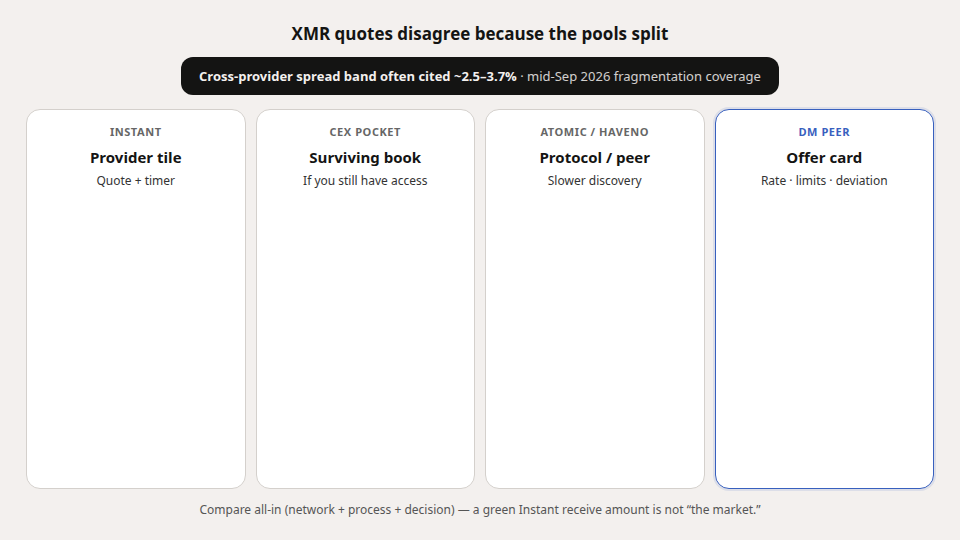
You open two “BTC → XMR” or “USDT → XMR” pages in the same hour and the receive amounts disagree by more than noise. That is not you misreading a calculator. Post-delisting Monero liquidity is fragmented — Instant desks, surviving CEX pockets, atomic tools, and peer books no longer share one deep pool. Mid-September 2026 coverage put median cross-provider spreads in the ~2.5–3.7% band for some swap indexes. This post is how to read that spread tax — and when a peer offer’s rate and deviation are the clearer sticker.
At a glance
| Field | Value |
|---|---|
| Topic | News/literacy: XMR quote fragmentation after CEX delistings |
| Product | Domestic Monero — peer offers with rate + market deviation |
| P2P assets (DM) | XMR ↔ BTC, LTC, ETH, SOL, USDT (ERC-20 on Ethereum mainnet) |
| Official entry | @domestic_monero_bot |
| Support | /support on that bot only — Trade #ref + trade state |
| What this is not | Price prediction; named Instant teardown; fiat on-ramp manual |
Disclaimer
This article is editorial opinion and general information, not investment advice. Spread figures move; check live quotes. Rules and venue availability vary by country.
Why the quotes disagree
Major venues delisted or region-restricted XMR (Binance globally in 2024; Kraken EEA and other cuts). Liquidity did not vanish — it split. Each route prices its own inventory, float risk, and compliance posture.
| Route class | How the “rate” is made |
|---|---|
| Instant / aggregator desk | Provider quote + timer; may float after you send |
| Surviving CEX pocket | Order-book mid — if you still have access |
| Atomic / Haveno-class | Peer or protocol price discovery, slower UX |
| Telegram peer offer (DM) | Maker rate + limits + on-card market deviation |
Delisting access playbook (where to go next): Delisting refugee crypto→XMR. This post is the price sticker problem once you already know you are off the big CEX book.
All-in beats “best rate”
A headline receive amount is not the trade. Before you send:
- Network — wrong USDT rail burns principal (TRC-20 trap; no ETH gas)
- Process — Instant custody window vs peer stages + six payment confirms
- Decision — abort signals before deposit (when to abort)
Pair-level spreadsheet habit: Best USDT→XMR quote vs all-in cost. Same columns work for BTC/SOL Instant tiles after a memecoin exit: SOL memecoin exit → XMR.
Opinion: treating a single Instant tile as “the market” is how fragmentation taxes you twice — once on the spread, again on the custody window you did not price.
What a peer offer shows that a tile often does not
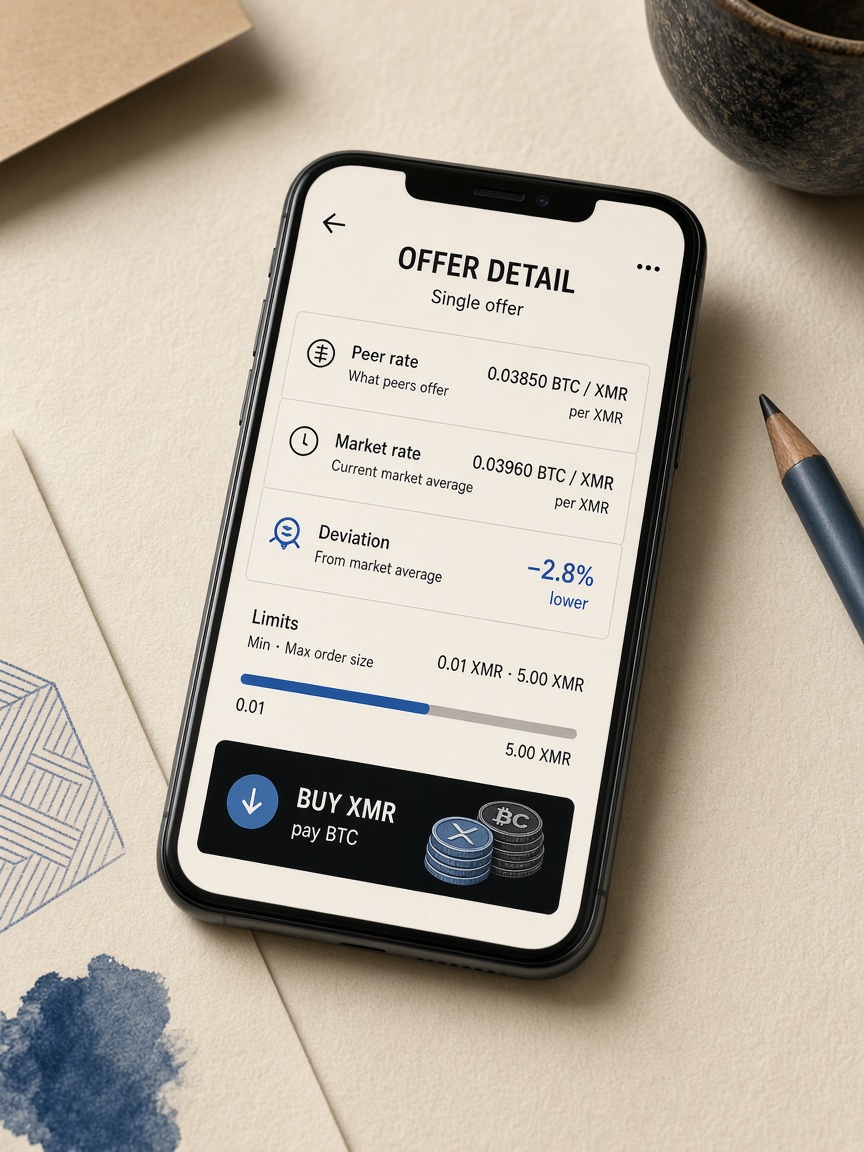
On Domestic Monero, an offer card is built for comparison:
- Maker rate
- Limits (min / max)
- Market rate / deviation context on public offer examples
- Named payment asset (SOL, USDT ERC-20, …)
You are not guessing whether “USDT” meant Tron. You are not racing a ten-minute fixed lock while Solana priority fees retry. You accept a card, move through stages, submit a TX hash, keep a trade share.
When the Mini App is the fitting next click
Open @domestic_monero_bot when:
- You already hold a listed crypto and want XMR without another Instant hop
- You care more about limits + deviation than a countdown tile
- You want stages and a trade share instead of a disposable deposit address
First taps: Accepting your first BUY offer. Venue matrix: Monero venues 2026.
Terms in this article
| Term | Meaning (public) |
|---|---|
| Fragmentation | Split liquidity after delistings — routes price independently |
| Deviation | Peer offer rate vs reference market rate on the card |
| All-in cost | Network + process + decision risk, not headline receive alone |
| Instant desk | Provider quote + deposit address + custody window |
| Offer | Peer BUY/SELL listing with rate and limits |
FAQ
Does Domestic Monero guarantee the best XMR price?
No. Peers set rates. The product shows the sticker; you compare.
Is a 3% Instant gap always a scam?
Not automatically — fragmented books can price that wide. Still verify the desk and compute all-in before sending.
Where is support?
Only /support on @domestic_monero_bot with Trade #ref.
Open the official Mini App
Open Offers, pick the asset you can send, and read rate + deviation + limits on one BUY card before you trust a single Instant receive amount — that is the sixty-second literacy move this fragmentation story asks for.
Open the app