Western Union’s Stablecard puts remittance on a stablecoin Visa rail

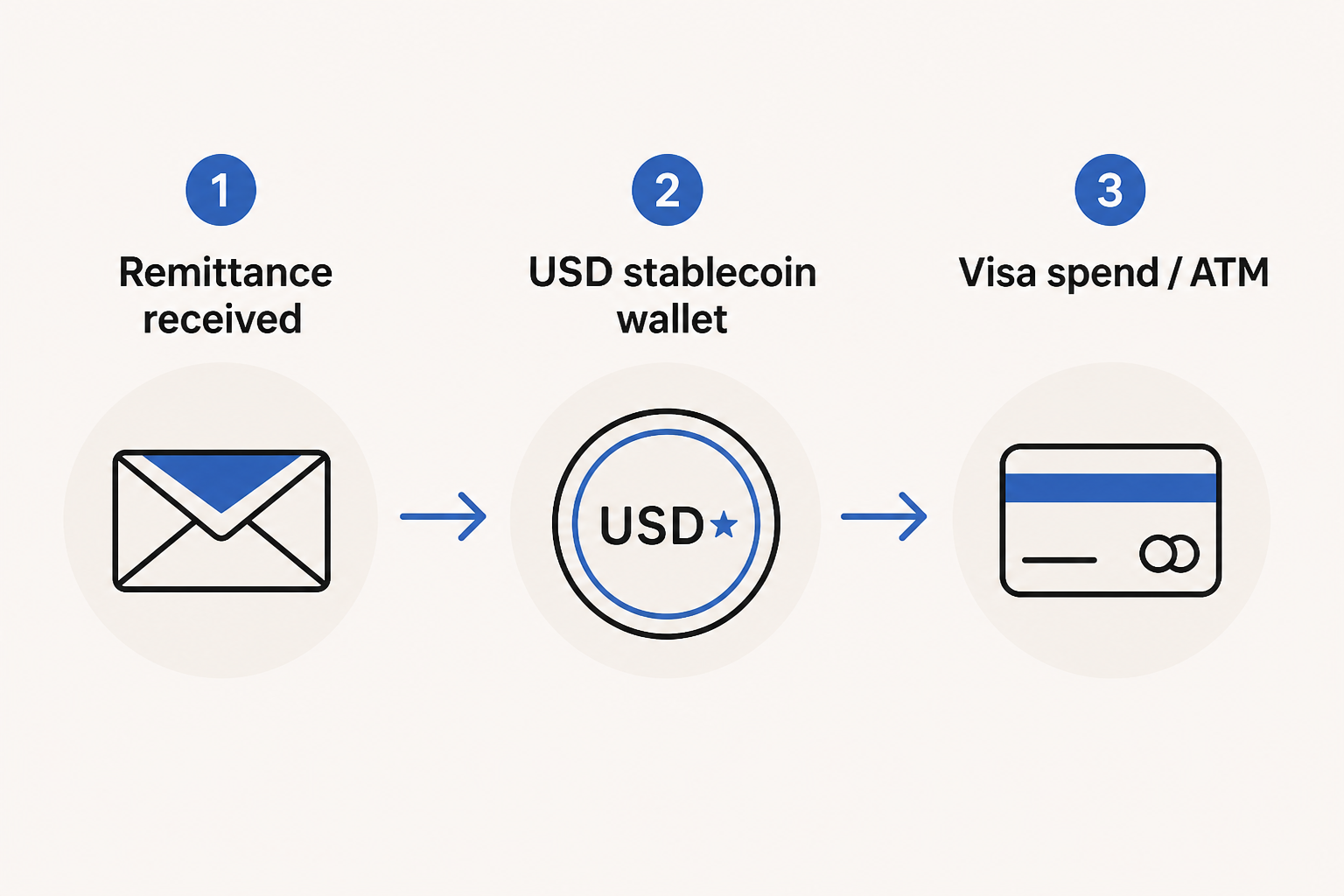
Legacy remittance is not standing still. On 4 August 2026, Western Union and stablecoin payments firm Rain launched Stablecard: receive eligible transfers into a wallet denominated in USDPT, hold dollar-linked balance, spend through Visa merchants and ATMs — initially in 37 markets, with public materials targeting expansion beyond 60.
This is a product and corridor story. It is not a second essay on the US GENIUS Act freeze mechanics — that lives in stablecoins got clearer rules.
At a glance
| Field | Value |
|---|---|
| Topic | Western Union Stablecard; USDPT; Visa; Rain partnership |
| Launch date | 4 August 2026 (public announcement) |
| Format | Remittance-industry explainer |
| Product mentioned | Domestic Monero — Telegram Mini App for P2P Monero trades |
| Official entry | @domestic_monero_bot |
| Support | /support on the official bot only (include Trade #ref + trade state) |
| Assets (P2P) | XMR ↔ BTC, LTC, ETH, SOL, USDT (ERC-20) |
| What it is not | GENIUS Act legal analysis; Brazil BCB eFX detail; on-chain Monero multisig |
What Stablecard is
Public announcement materials describe Stablecard as:
| Layer | Detail |
|---|---|
| Issuer / token | USDPT — issued by Anchorage Digital Bank on Solana, marketed as redeemable 1:1 for US dollars |
| Distribution | Western Union Stablecard app — virtual Visa card, Apple Pay / Google Pay add |
| Funding routes | Eligible Western Union remittance redirect into Stablecard; transfer USDPT from compatible wallets/exchanges |
| Spend | Visa merchants, ATMs where supported |
| Geography | 37 markets at launch; expansion narrative toward 60+ |
| Onboarding | Identity verification required — store listings cite no credit check / no minimum balance, not “anonymous signup” |
Western Union’s Q2 2026 narrative emphasises digital transaction growth (+25% YoY in announcement coverage) — Stablecard fits a wider shift from cash pickup only to wallet + card delivery.
How this differs from GENIUS / issuer freeze talk
Readers researching “stablecoins” in 2026 hit two different questions:
| Question | Where to read |
|---|---|
| Can a US payment stablecoin issuer freeze my balance on lawful order? | GENIUS / freeze explainer |
| Is legacy remittance adopting stablecoin + card delivery? | This post |
Stablecard ** assumes** a regulated issuer stack (USDPT, bank issuer, KYC gate). That is the opposite pitch from default-privacy chain money — but it may be the opposite user too: someone optimising dollar receipt + spend, not on-chain graph minimisation.
Do not import GENIUS paragraphs here. The lesson for Stablecard is narrower: remittance brands now package stablecoin wallets with card spend, not only cash pickup windows.
How this differs from Brazil BCB eFX (Res. 561)
Brazil’s Resolução 561 removes stablecoins from eFX cross-border settlement between supervised payment institutions from 1 October 2026. That is wholesale settlement plumbing inside Brazil’s regulated perimeter.
Western Union Stablecard is a consumer product in listed markets — different jurisdiction, different layer. If your corridor touches both, treat them as separate compliance objects. Brazil detail: Two Brazil BCB rules.
Attestation and supply transparency
Announcement coverage notes monthly independent reserve attestation reports for USDPT and public Solana explorer visibility of outstanding supply — with reporting lag versus live on-chain figures called out in trade press. Treat attestations as issuer disclosure, not a protocol privacy guarantee.
Archive does not endorse USDPT, Rain, Western Union, or Anchorage Digital Bank. Product facts here are for corridor mapping only.
Why P2P Monero readers might still care
Stablecard optimises KYC remittance + dollar spend. Monero P2P optimises a different problem: peer conversion into default-privacy chain money when users already hold BTC/LTC/ETH/SOL/USDT and want XMR without a CEX account.
The comparison is workflow, not morality:
| Need | Fitting rail |
|---|---|
| Family receives USD-linked spendable balance + Visa | Stablecard-class products (KYC) |
| Holder converts crypto → XMR with staged peer trade state | P2P offer path — BTC/USDT → XMR guide |
| Long-term issuer-free savings | Self-custody XMR — self-custody habits |
Domestic Monero is one Telegram peer market: XMR ↔ BTC, LTC, ETH, SOL, USDT (ERC-20), seller stakes to Multisig Trade Wallet, buyer submits TX hash, per-asset confirmations (Payment proof and confirmations), settle with trade share. Official entry: @domestic_monero_bot.
Terms in this article
| Term | Meaning here |
|---|---|
| USDPT | Western Union’s dollar-linked stablecoin on Solana (public materials) |
| Stablecard | WU wallet + virtual Visa product launched Aug 2026 |
| Remittance | Cross-border money transfer — often cash pickup historically |
| KYC | Identity verification — required for Stablecard onboarding |
| Attestation | Third-party report on reserves backing issued tokens |
FAQ
When did Stablecard launch?
Public launch announced 4 August 2026.
Is Stablecard no-KYC?
No. Public store listings require identity verification.
Is this the same as GENIUS?
No. GENIUS is US payment stablecoin law. Stablecard is a remittance product using USDPT.
Does Stablecard replace Monero P2P?
Different job. Stablecard is fiat-linked remittance delivery. Domestic Monero is crypto ↔ XMR peer trading in Telegram.
Can I buy XMR with Stablecard?
Not described in public Stablecard materials reviewed for this post. Acquisition paths for XMR: where to buy when exchanges delist.
Next steps
- Separate remittance product research from issuer freeze law — link both, don’t merge.
- If converting crypto to XMR, compare peer vs swap custody: privacy-tax swap trap.
- Verify official bot before any P2P trade: Verify official channels.
Marketing site: domesticmonero.com.
Related: Brazil BCB August rules · GENIUS stablecoin freeze · BTC/USDT → XMR without exchange