Best USDT to XMR rate — why the winning quote is not the all-in cost

You opened three tabs for best USDT to XMR rate. Aggregators and Telegram bots race to show the fattest XMR-out number. That tile is a quote, not an all-in cost. This post is for people already rate-shopping: what to add under the headline number, and when a structured peer offer is the better line on the spreadsheet.
At a glance
| Field | Value |
|---|---|
| Topic | Demand SERP: USDT→XMR “best rate” vs all-in cost |
| Product | Domestic Monero — peer offers (not an instant swap) |
| P2P assets (DM) | XMR ↔ BTC, LTC, ETH, SOL, USDT (ERC-20 on Ethereum mainnet) |
| Official entry | @domestic_monero_bot |
| Support | /support on that bot only — Trade #ref + trade state |
| What this is not | Live rate API; named aggregator teardown; Instant-speed claim for Domestic Monero |
Quote vs all-in — three columns
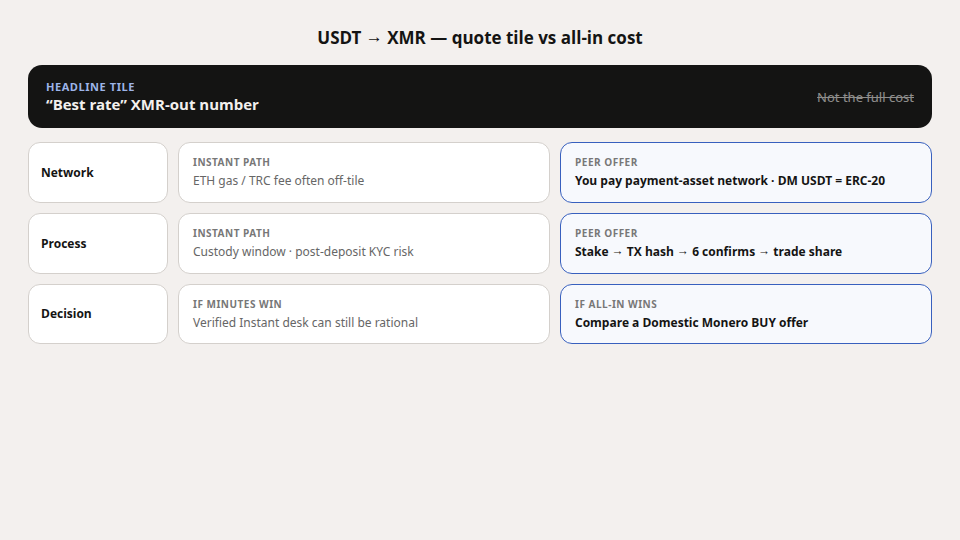
| Column | Instant / aggregator quote | What it hides | Peer offer (DM-shaped) |
|---|---|---|---|
| Headline rate | XMR you “get” if everything works | Spread vs a quiet mid you trust | Offered peer rate + limits |
| Network cost | Often “you pay gas / TRC fee yourself” | ERC-20 USDT needs ETH gas; wrong network = loss | Same: you pay the payment-asset network; DM USDT = ERC-20 only |
| Process risk | Countdown deposit + provider custody window | Post-deposit KYC / hold / retry tax | Stake → TX hash → per-asset confirmations (Payment proof and confirmations) → trade share settle |
Affiliate pages optimize column one. Searchers lose money in columns two and three. Privacy-tax framing: Telegram instant swap bots and the privacy tax. Mid-funnel abort after a quote: Got a swap quote — when to abort.
A five-line all-in scratch pad
Before you deposit anywhere, write five lines (fictional numbers OK):
- Reference mid you trust for USDT/XMR right now
- Quoted XMR-out (or peer offer XMR)
- Network fee in USD-ish terms (ETH gas for ERC-20; TRC fee if that is your rail)
- Time / custody you accept (minutes of provider hold vs peer stages)
- KYC / hold clause — yes, maybe, or hard no
If line 5 is “hard no” and the quote fine print says verification after deposit, the “best rate” is irrelevant — abort. If line 3 assumes TRC-20 but your destination only takes ERC-20, fix the rail first: Hold TRC-20 USDT, want XMR.
When the peer offer wins the spreadsheet
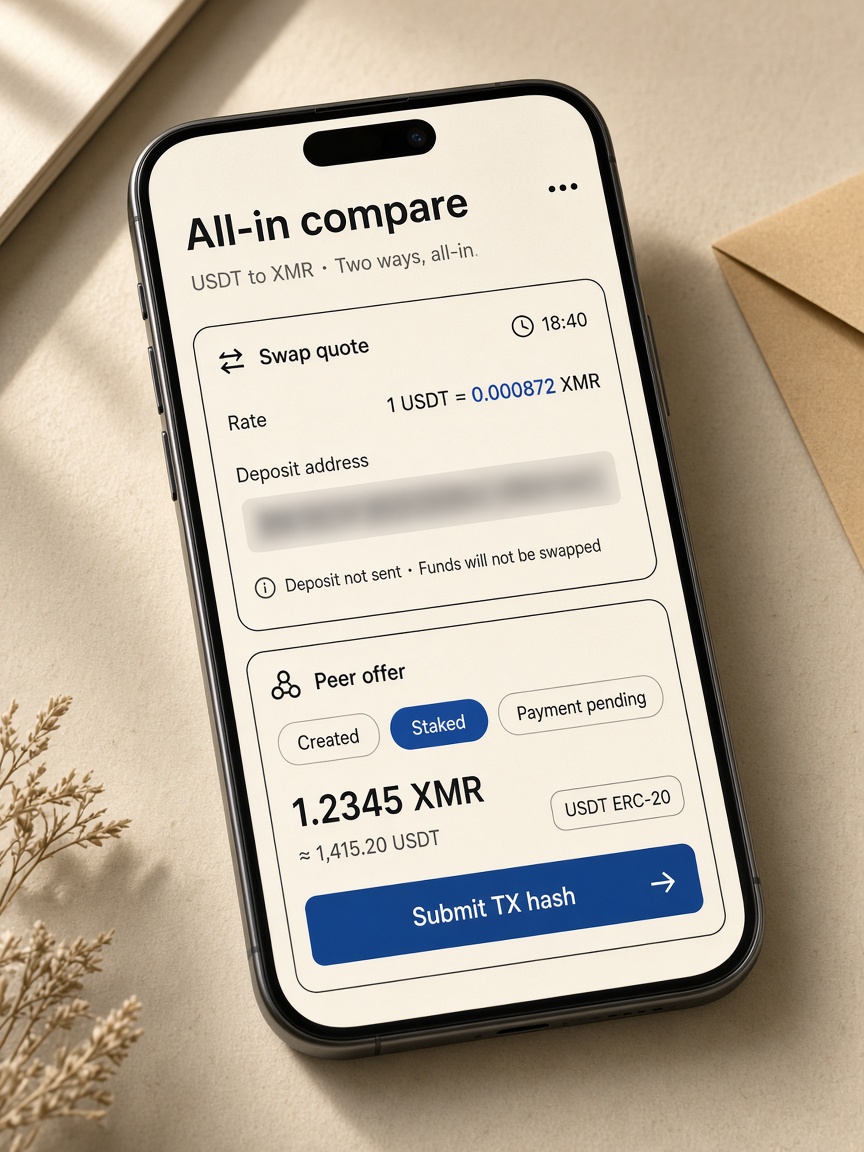
Prefer a Domestic Monero BUY offer paid in USDT ERC-20 when you want:
- A visible peer and stage chips instead of a single deposit address
- TX hash + confirmations as proof
- A trade share you keep offline
- No Instant countdown as the product promise
Flow shape: How to convert USDT to XMR P2P · Telegram swap bot vs Mini App peer offers.
Keep the aggregator path when minutes dominate, the handle is independently verified, and you accept custody window + possible compliance friction.
Terms in this article
| Term | Meaning (public) |
|---|---|
| Quote | Provider rate + deposit instructions before send |
| All-in cost | Rate + network + process / KYC risk — not the tile alone |
| Offer | Peer BUY/SELL listing with rate and limits |
| Trade share | Authorization Credentials for settlement |
| Privacy tax | Extra all-in cost for “no-KYC” Instant paths that still escalate |
FAQ
Is the highest XMR-out number always the best deal?
No. Network fees, wrong-chain risk, and post-deposit holds can erase the tile advantage.
Does Domestic Monero show aggregator-style best-rate rankings?
No. You browse or accept peer offers with stated rates and limits — not a multi-provider quote race.
Where is support?
Only /support on @domestic_monero_bot with Trade #ref.