Trocador’s partner grades are not peer Offers — compare before you deposit

You typed something like Trocador Monero or Trocador XMR. Guides answer with the aggregator: compare floating and fixed rates, filter partners by letter-grade KYC risk, paste a fresh Monero subaddress, send to the partner deposit address. That tooling is real — Tor mirrors, no-account aggregator layer, A–D labels. It is still an Instant-shaped path: coins leave your wallet into a provider window. Letter grades reduce surprise; they do not turn the deposit into a peer offer card.
At a glance
| Field | Value |
|---|---|
| Topic | Competitor displace: Trocador Instant-aggregator SERP → peer Offers before partner deposit |
| Product | Domestic Monero — Telegram Mini App peer offers |
| P2P assets (DM) | XMR ↔ BTC, LTC, ETH, SOL, USDT (ERC-20 on Ethereum mainnet) |
| Official entry | @domestic_monero_bot |
| Support | /support on that bot only — Trade #ref + trade state |
| What this is not | Trocador support script; partner refund guarantee; Instant-speed claim |
Disclaimer
This article is editorial opinion and general information, not legal or tax advice. Aggregator and partner policies change; read the live grade, Terms, and refund notes before you send. Rules vary by country.
What the grade actually buys you
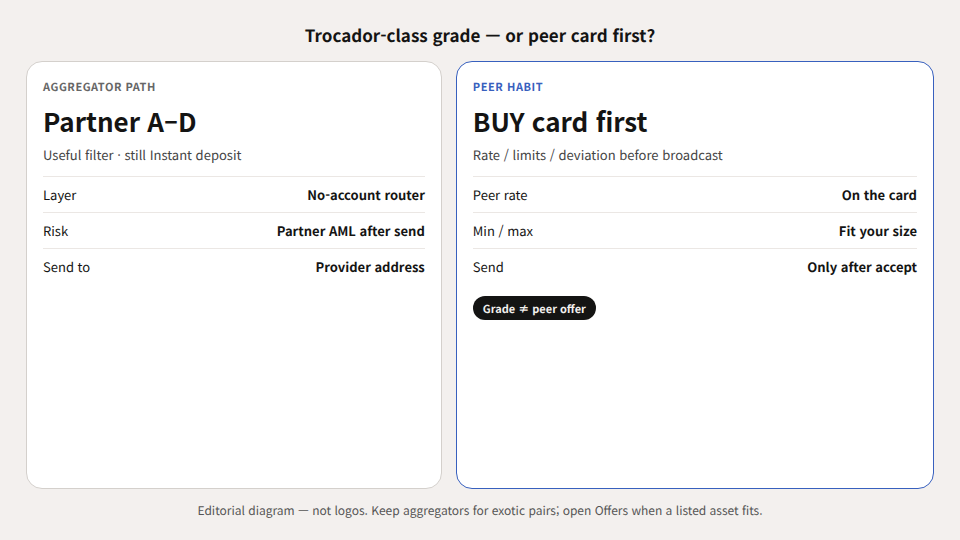
Trocador (and similar Monero-community aggregators) does not custody the swap in the Instant sense — it routes you to a partner desk. Public copy is clear: each partner runs its own AML/KYC policy; a “Never KYC” aggregator layer does not bind every upstream. Grades and risk filters are the useful part of the product.
What they do not replace:
- Reading a peer rate / limits / deviation on a counterparty card
- Sending only after you accept a trade
- Avoiding a post-deposit compliance mailbox when a partner flags the deposit
Same Instant failure family after the send: EasyBit KYC after deposit · Nanswap KYC after deposit · ChangeNOW KYC hold. Fee framing: Privacy tax on KYC Monero swaps. Abort before deposit: Got a swap quote — when to abort.
Next-time habit (peer compare first)
- Verify @domestic_monero_bot — Verify official.
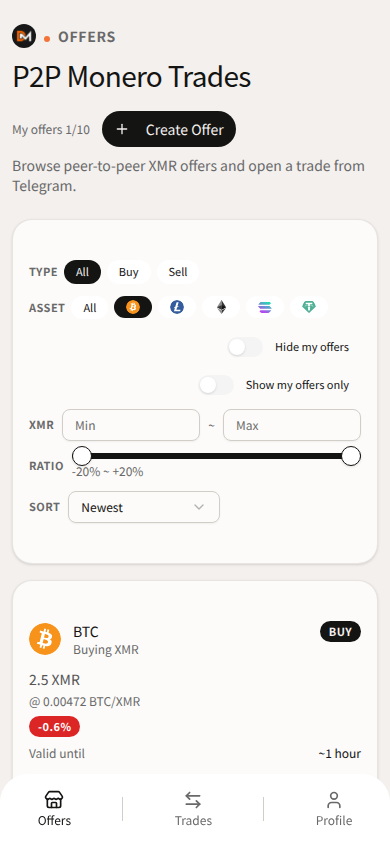
- Open Offers. Filter the asset you were about to Instant-route (BTC, ETH, USDT ERC-20, LTC, SOL…).
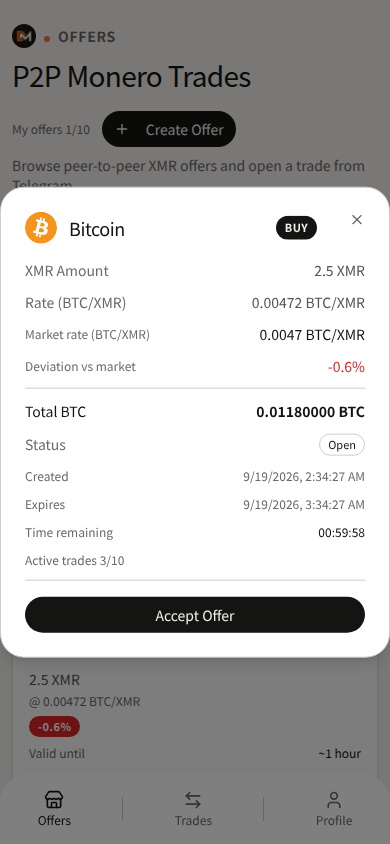
- Put the aggregator’s best “you receive” XMR next to the peer card’s rate / limits / deviation.
- If the peer card wins on all-in and fits min/max, accept — then send to the trade address, not the partner deposit.
- Save the trade share. Support is
/support+ Trade #ref only.
Domestic Monero does not promise Instant-minute settlement. It promises a readable peer card before you risk a partner AML pause.
When Trocador-class routing is still the right tool
Keep the aggregator when you need an exotic pair DM does not list, when the peer book has no size for you, or when minutes matter more than reading a counterparty. Prefer the lowest KYC-risk grade you can live with — and still treat every partner deposit like Instant: abort signals first, small test second.
DAI stacks that Instant owns on SERP but DM does not list: DAI to XMR — hop then peer.
Terms in this article
| Term | Meaning (public) |
|---|---|
| Aggregator | Quote router that sends you to a partner Instant desk |
| Partner grade | Desk KYC/AML risk label — not a peer offer |
| Instant deposit | One-time provider address + countdown |
| Offer | Peer card: rate, limits, payment asset |
| Trade share | Credential you keep for settlement / refund paths |
FAQ
Does “no KYC on Trocador” mean the partner never asks?
No. The aggregator layer usually asks for nothing. Partners can still pause a flagged deposit and request ID / SOF after you send.
Does Domestic Monero replace Trocador for every pair?
No. DM lists BTC, LTC, ETH, SOL, USDT ERC-20 against XMR. Exotic Instant pairs may stay Instant — with eyes open.
USDT network on DM?
ERC-20 on Ethereum mainnet only — not TRC-20/BEP-20.
What to do next
Open @domestic_monero_bot → Offers → filter the asset you were about to route through an Instant partner → read peer rate and limits before you send.
Open the app