Stablecoins got clearer rules — including who can freeze them

Payment stablecoins are winning on convenience: dollar-ish units, fast rails, deep liquidity. In 2025–2026 they also got clearer US rules — and those rules are honest about a property many holders ignore until it bites: a payment stablecoin issuer is expected to be able to freeze, block, or seize tokens when a lawful order says so.
That is not a conspiracy thread. It is how regulated “digital cash” is being written.
At a glance
| Field | Value |
|---|---|
| Topic | GENIUS Act (US payment stablecoins); freeze / lawful-order capability; USDT reality; Monero as non-issuer money |
| Format | News explainer + practical checklist (no composite character story) |
| Product mentioned | Domestic Monero — Telegram Mini App for P2P Monero trades |
| Official entry | @domestic_monero_bot |
| Support | /support on the official bot only (include Trade #ref + trade state) |
| Assets (P2P) | XMR ↔ BTC, LTC, ETH, SOL, USDT (ERC-20 on Ethereum mainnet only) |
| What it is not | Legal advice; tax advice; a claim that KYC-free equals lawful anonymity; on-chain Monero multisig |
What GENIUS actually locked in
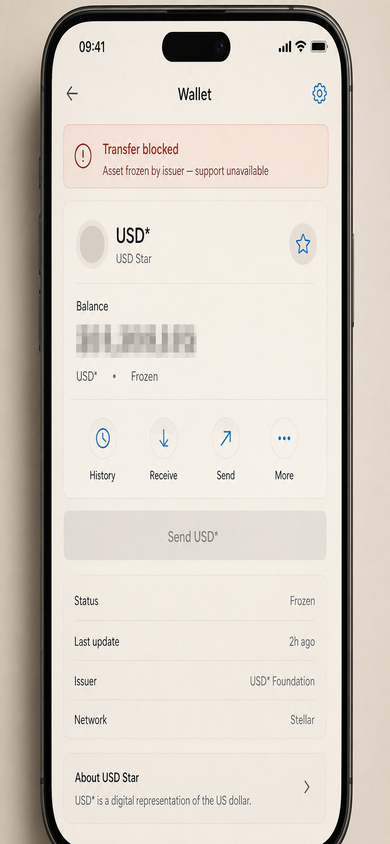
The GENIUS Act (Guiding and Establishing National Innovation for U.S. Stablecoins) became US public law in July 2025. It creates a federal frame for payment stablecoins: who may issue, how reserves must be held, disclosure expectations, and — critically — technical and policy capacity to comply with lawful orders that require freezing, blocking, or preventing transfers of issued tokens.
On 18 August 2026, the US Treasury published a notice of proposed rulemaking under that framework: how issuance, offer, and sale rules will apply to US persons and to digital asset service providers carrying payment stablecoins. The practical calendar in public commentary points toward phased effectiveness into 2027–2028, including tighter conditions on which foreign-issued tokens US service providers may keep on the “buy” menu.
Separate from GENIUS, the CLARITY Act (market-structure bill for crypto commodities/securities turf) was still not law as of late August 2026 — House-passed, Senate procedural vote eyed for 15 September 2026. Do not confuse the two:
| Instrument | Job | Personal-money takeaway |
|---|---|---|
| GENIUS Act | Rules for payment stablecoins | Dollar tokens are designed with an issuer control plane |
| CLARITY Act | Market structure (SEC/CFTC-style clarity for venues/tokens) | Industry plumbing; weaker direct lesson for “can my balance be switched off?” |
For people who care about custody without a remote kill switch, GENIUS is the nearer headline. CLARITY context: CLARITY Act — what the September Senate vote is actually about.
Freezes are already a product feature
Long before GENIUS rule text finished baking, major stablecoin issuers demonstrated address-level freezes on public chains. Public reporting in 2026 documented large USDT freezes (including a widely covered ~$72M Tron blacklist event in June 2026 after on-chain investigators flagged a large flow). Whatever you think of any specific case, the mechanism is the same:
- Tokens live under an issuer-controlled contract or blacklist set.
- A compliance decision updates that set.
- Affected balances stop moving — even if you still “see” them in a block explorer.
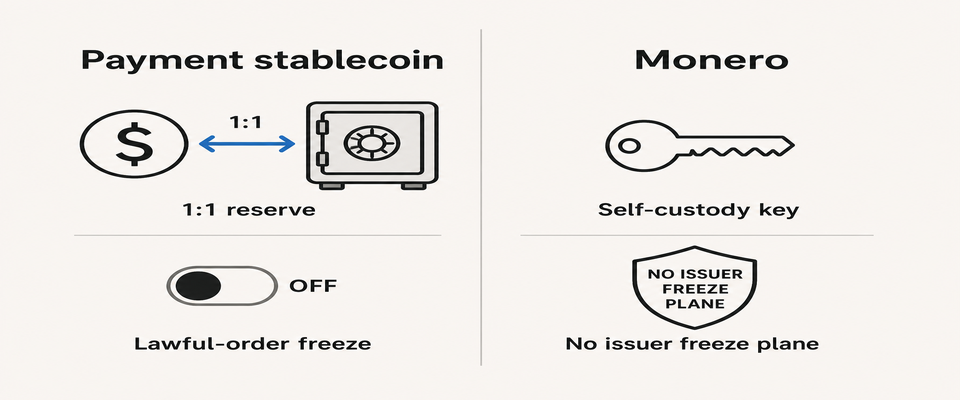
That is the opposite of Monero’s design: no issuer, no contract admin key that blacklists your output, no company helpdesk that can unstick a spend.
What this means in real life (without the slogans)
If you use USDT/USDC as working capital — invoices, remittances, DeFi collateral, parking between trades — treat them as bank-adjacent dollars with a blockchain UX, not as bearer cash.
Practical habits that match the rules as written:
| Habit | Why |
|---|---|
| Assume freezes are possible | Lawful-order capacity is a design requirement, not an edge case |
| Prefer self-custody wallets for long holds of any asset | Exchange insolvency and issuer freezes are different risks; both exist |
| Do not treat “already on-chain” as “uncensorable” | Transparent stablecoins remain issuer-governed |
| Separate price stability from seizure resistance | You often cannot maximize both in one token |
| Keep official channel hygiene | Fake “support” accounts love freeze panic |
Monero answers a different question: money whose protocol does not ship an issuer freeze API. It does not answer tax law, sanctions law, or “will my local ATM take this.” Volatility, thinner CEX books, and delistings are the trade.
Broader holder habits: Self-custody habits for people who want money they can still move.
If you already hold USDT or BTC and want XMR
You do not need a morality play. You need a conversion machine:
| Path | Shape | Tradeoffs |
|---|---|---|
| Instant swap / aggregator | Send A, receive XMR | Simple choreography; provider trust; limits/KYC escalations possible |
| Peer offer (P2P) | Browse/create offer; stake; payment proof; settle | Visible stages; matching wait; you must keep trade credentials |
Domestic Monero is one peer path inside Telegram: BTC, LTC, ETH, SOL, USDT (ERC-20) ↔ XMR, no user-to-user chat, seller stakes XMR to the displayed Multisig Trade Wallet, buyer submits a TX hash, per-asset confirmations (Payment proof and confirmations), settle with your trade share. Official entry only: @domestic_monero_bot.
Detail: BTC or USDT → XMR without an exchange account.
On Domestic Monero, USDT means ERC-20 on Ethereum mainnet — not TRC-20, BEP-20, or SPL. Wrong network can lose funds.
Neither path is a legal shield. Peer trading does not erase reporting duties where you live. KYC-free product language ≠ “invisible to law”: Buy Monero without KYC — what that means.
Terms in this article
| Term | Meaning here |
|---|---|
| Payment stablecoin | Dollar-referenced token under issuer rules (GENIUS’s focus) |
| Lawful order | Court/agency command the issuer must be able to obey (freeze/block/seize class) |
| Multisig Trade Wallet | Address holding staked XMR for an active Domestic Monero trade; release/refund is 2-of-3-gated with trade shares |
| Trade share | Authorization credentials issued at trade creation — loss can block payout |
| Trade #ref | Short public id for /support |
FAQ
Did GENIUS ban USDT?
No. It frames how payment stablecoins may be issued and offered in the US system over time — including freeze capability and service-provider constraints. Offshore tokens may face access friction on US venues as rules phase in; that is not the same sentence as “token deleted from every chain.”
Can Tether (or another issuer) freeze my USDT?
Issuers have repeatedly frozen addresses on public chains. GENIUS pushes that capability from “issuer policy” toward regulated expectation for covered payment stablecoins.
Does Monero have a freeze button?
Not at the issuer layer — there is no Monero Inc. blacklist key. You can still lose coins to scams, wrong addresses, or lost seeds. Protocol privacy ≠ operational safety.
Is holding Monero illegal because of GENIUS?
GENIUS targets payment-stablecoin issuance and offering rules. It is not a personal ban on self-custodied XMR. Local law still applies where you live; this article is not legal advice.
Where do I open Domestic Monero?
Only @domestic_monero_bot. Help: /support with Trade #ref — never random DMs.
Next steps
- Separate stable value from uncensorable value in your own checklist.
- If converting BTC/USDT → XMR, compare swap vs peer offer mechanics.
- Open the official bot only after handle verification.
Marketing site: domesticmonero.com.
Related: CLARITY Act September Senate vote · Self-custody habits · Where to buy Monero when exchanges delist · Verify official channels