Russia licensed crypto rails. Privacy coins were not on the guest list.

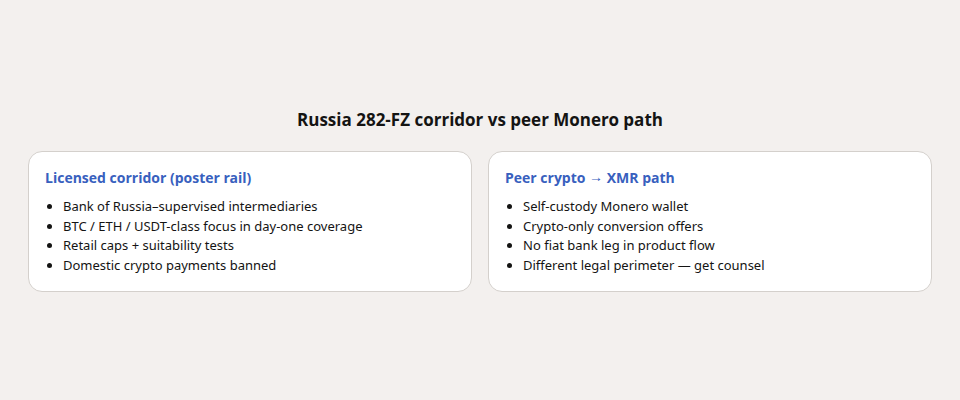
On 1 September 2026, headlines said Russia legalized crypto trading. What actually went live was narrower: a licensed corridor for digital-currency circulation through Bank of Russia–supervised intermediaries — with domestic crypto payments still banned, retail limits, and a transition clock running toward 1 July 2027.
Privacy-by-default assets such as Monero were never the marketing poster for that corridor.
At a glance
| Field | Value |
|---|---|
| Topic | Russia Federal Law No. 282-FZ (signed 4 Aug 2026; main rules from 1 Sep 2026); licensed rails; P2P transition; privacy-coin perimeter |
| Format | Calendar explainer with citeable law-firm and industry summaries |
| Key sources | Pepeliaev Group alert (5 Aug 2026) · Coinspot 282-FZ timeline overview · CoinGape day-one licensed trading summary |
| Product mentioned | Domestic Monero — crypto-only P2P Monero offers |
| Official entry | @domestic_monero_bot |
| Support | /support on the official bot only |
| Assets (P2P) | XMR ↔ BTC, LTC, ETH, SOL, USDT (ERC-20 on Ethereum mainnet only) |
| What it is not | Legal advice for Russian residents; sanctions-evasion guide; claim P2P is “banned today”; tax evasion manual |

Two dates that search results flatten
| Date | What public summaries say happens |
|---|---|
| 1 September 2026 | Main part of 282-FZ (+ companion 283-FZ amendments) applies: licensing architecture for organizers of digital-currency circulation, digital depositories, exchange organizations, etc. |
| 1 July 2027 | Transition ends for many resident transaction paths — activity funnels toward regulated participants (or direct deals with them), with banking pressure on unregistered venues expected to rise |
Pepeliaev Group’s August 2026 alert is useful because it is law-firm primary reading, not a Telegram rumor card: digital currencies are recognized as property; professional participants are enumerated; domestic use as payment inside Russia is prohibited with listed exceptions (notably certain foreign-trade settlements).
Day-one industry summaries (e.g. CoinGape) add the retail product shape people will actually feel: suitability testing, a ~300,000 RUB annual-style cap narrative for non-qualified retail on licensed platforms, and an initial focus on BTC / ETH / USDT-class organized trading — not a privacy-coin showcase.
What “legalized” does not mean
| Headline compression | Closer reading |
|---|---|
| “Crypto is fully legal now” | Ownership was already evolving; 282-FZ builds a supervised circulation regime |
| “P2P is banned on day one” | Summaries say P2P is not automatically illegal from 1 Sep 2026; sensitivity rises through the July 2027 transition |
| “Privacy coins got a licensed home” | Reporting on eligibility thresholds and AML expectations points the opposite way: opaque assets stay outside the poster corridor |
| “You can pay for coffee in BTC” | Domestic payment use remains prohibited under the territorial rules described by Pepeliaev |
Archive’s editorial frame matches other jurisdictions we already covered: regulators prefer intermediated, reportable rails (DAC8/CARF, EU exit ban). They do not build those rails to celebrate default-privacy coins.
Why Monero readers should care anyway
Even if you never touch a Russian licensed platform, 282-FZ is a citeable pattern:
- Legalize the choke point — brokers, depositories, organized trading.
- Cap and test retail — suitability + annual limits in industry summaries.
- Ban domestic payments — keep crypto out of everyday cashier flows.
- Time-box gray P2P — transition language toward 2027.
- Leave default privacy off the marketing board — AML analytics and eligibility screens prefer transparent ledgers.
That pattern is why delisting trackers and self-custody habits keep showing up on Archive: the usable XMR path is rarely the licensed retail poster.
Crypto-only peer paths (product perimeter)
Domestic Monero is not a Russian licensed exchange, broker, or digital depository. It is a Telegram Mini App for crypto-to-crypto Monero offers (no fiat bank leg in the product flow). Official entry is only @domestic_monero_bot.
If your question is “how do people convert BTC/USDT to XMR without exchange-account theater,” start with BTC/USDT → XMR without exchange account and buy Monero without KYC — what it means.
If your question is “what does Russian resident law require of me,” stop here and talk to local counsel — Archive will not invent a compliance checklist for you.
Disclaimer
This article is editorial opinion and general information, not legal, tax, or sanctions advice. Russian statutes, Bank of Russia regulations, and enforcement practice change; consult qualified counsel for your situation. Nothing here is a guide to evade law or sanctions.
Terms in this article
| Term | Meaning here |
|---|---|
| 282-FZ | Federal Law “On Digital Currencies and Digital Rights” (signed 4 Aug 2026) |
| 283-FZ | Companion amending law referenced in the same package |
| Organizer of circulation | Licensed/registered intermediaries (trading organizer, broker, digital depository, exchange organization, etc.) |
| Digital depository | Entity recording / transferring rights to digital currencies under the Law |
| Transition (to 1 Jul 2027) | Period before many resident paths must run through regulated participants |
| Default privacy | Network hides transaction metadata by design (e.g. Monero) |
FAQ
Did Russia ban owning crypto on 1 September 2026?
Public law-firm summaries say ownership as property is recognized; the Law regulates how circulation is organized, not a blanket ownership ban.
Is P2P illegal immediately?
Day-one explainers say not automatically. Watch the 1 July 2027 transition and banking enforcement — do not treat a 2026 headline as a 2027 court ruling.
Are privacy coins listed on the new licensed platforms?
Industry day-one coverage emphasizes BTC / ETH / USDT-class rails and AML-friendly eligibility. Treat “privacy coin listing” claims as unverified until a licensed venue publishes them.
Does Domestic Monero operate under 282-FZ as a Russian organizer?
No claim of that kind. It is a Telegram P2P offer product. Different perimeter entirely.
Official entry / support?
@domestic_monero_bot · /support only.
Next steps
- Read a law-firm or primary text summary — not a reshare card.
- Separate licensed retail corridor from coins you self-custody.
- If you need XMR liquidity outside CEX posters, map instant swap vs P2P before a deadline forces a bad trade.
Related: EU banned the exit, not Monero · India privacy-coin ban — half the story · Self-custody habits · Verify official channels