The privacy tax — what KYC Monero swap routes actually cost you

You search buy Monero no KYC, pick an instant swap that promises no sign-up, send BTC or USDT, and watch the timer tick. Twenty minutes later the page turns yellow: Additional verification required. Your coins already left your wallet. They sit in someone else’s custody while you decide whether to upload a passport for the privacy asset you were trying to reach quietly.
That is not bad luck. It is the business model meeting a tightening surveillance stack.
At a glance
| Field | Value |
|---|---|
| Topic | Post-deposit KYC on “no-KYC” swaps; fee stacking; stablecoin/Travel Rule context; P2P alternative |
| Format | News explainer + fee table (no composite character story) |
| Product mentioned | Domestic Monero — Telegram Mini App for P2P Monero trades |
| Official entry | @domestic_monero_bot |
| Support | /support on the official bot only (include Trade #ref + trade state) |
| Assets (P2P) | XMR ↔ BTC, LTC, ETH, SOL, USDT (ERC-20 on Ethereum mainnet only) |
| What it is not | Tax or sanctions evasion guidance; “fully anonymous”; on-chain Monero multisig; endorsement of any third-party swap |
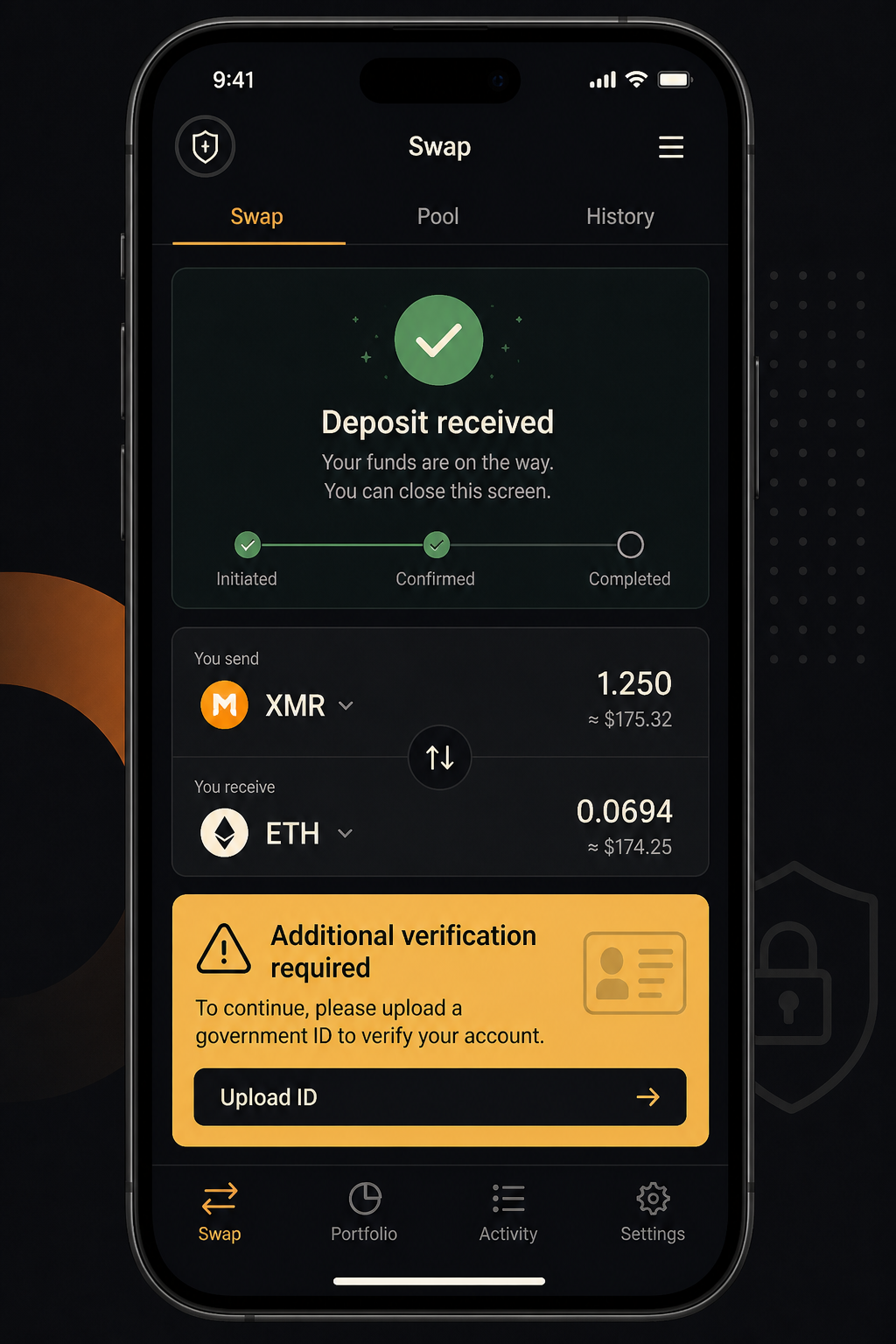
The post-deposit trap
Instant swap sites compete on speed and a landing page that says no account. What they rarely advertise is when KYC can appear.
Industry reporting in 2025–2026 describes a recurring pattern:
- You send the deposit asset.
- The provider’s risk engine scores the route (coin pair, amount, source address analytics, privacy-coin flag).
- After the deposit clears — sometimes before XMR is released — support requests ID, a selfie, or source-of-funds notes.
- Refusing may eventually yield a refund to the sending address, but complaint logs document weeks to months of waiting — not the “instant” you paid for.
The leverage is structural. Once funds sit in custodial limbo, you are not choosing whether to verify. You are choosing between documents you did not plan to share and coins you cannot move.
Providers have little incentive to publish trigger rules upfront. “We may freeze your swap pending verification” is bad for conversion. Checking a provider’s historical KYC likelihood for your specific pair before you send anything is the only defense that is not hostage negotiation.
The privacy tax is not one line item
Swap sites often show no separate fee. The cost hides in the spread against a mid-market rate, plus network fees on both legs, plus time risk on floating quotes, plus the binary cost of a KYC escalation.
Published comparisons for BTC→XMR instant routes in 2026 commonly land around ~0.5%–4% all-in depending on fixed vs floating rate, liquidity, and pair — before you count a failed swap or a refund wait.
| Layer | What it is | Typical pain |
|---|---|---|
| Spread | Embedded markup vs mid price | 0.5%–3%+ on privacy pairs |
| Network fees | BTC/ETH/USDT send + XMR receive | Visible; still stacks |
| Time / float risk | Floating rate drifts while XMR confirms | “Estimate” ≠ payout |
| KYC escalation | Post-deposit review | Privacy goal defeated; funds stuck |
| Retry tax | Second provider after first freeze | Pay spread again |
Worked example (illustrative, not a quote)
Assume $10,000 BTC → XMR via a “no-KYC” instant swap at 2.5% effective spread:
| Step | Notional left | Notes |
|---|---|---|
| Start | $10,000 | Your BTC leaves your wallet |
| After spread (~2.5%) | ~$9,750 XMR-equivalent | Already worse than a tight CEX book if you had one |
| KYC freeze → refund minus fees | ~$9,700 back (variable) | Weeks lost; transparent-chain trail remains |
| Second attempt (+2.5%) | ~$9,456 XMR-equivalent | Compound privacy tax |
| Third attempt (+2.5%) | ~$9,220 XMR-equivalent | Chasing Monero with a passport pipeline |
Three “simple” hops can burn ~8% without counting network fees or opportunity cost — and you may still hand over ID on the attempt that finally clears.
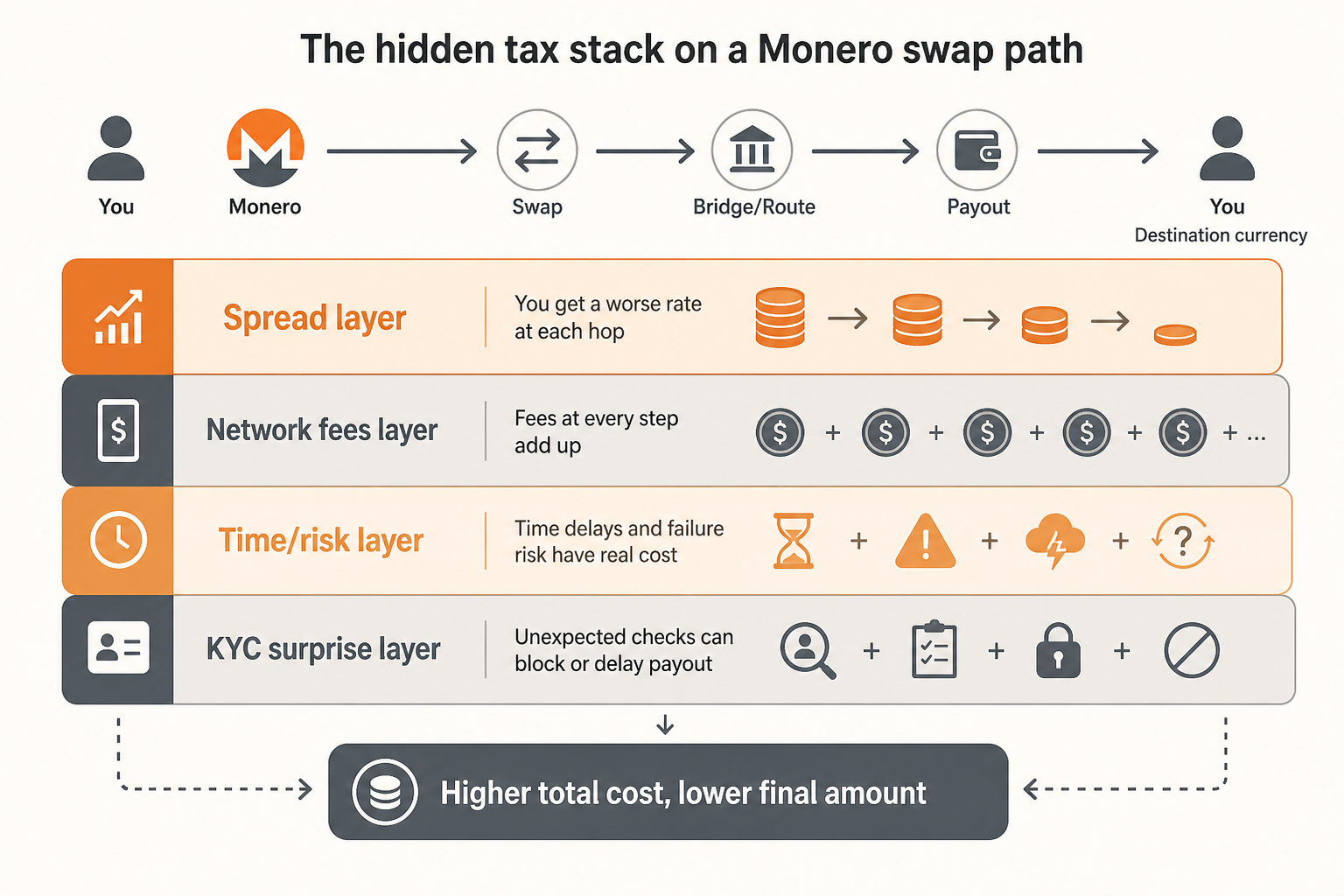
CEX routes are not saints — KYC there is up front, and delistings block XMR entirely in many regions (Kraken India schedule, EU privacy-coin pressure). The insult is paying a privacy premium on a path that still demands your face mid-flight.
The censorship stack you swap through
Monero buyers in 2026 rarely start from cash. They start from surveilled rails:
| Rail | What tightened recently | Why it matters before XMR |
|---|---|---|
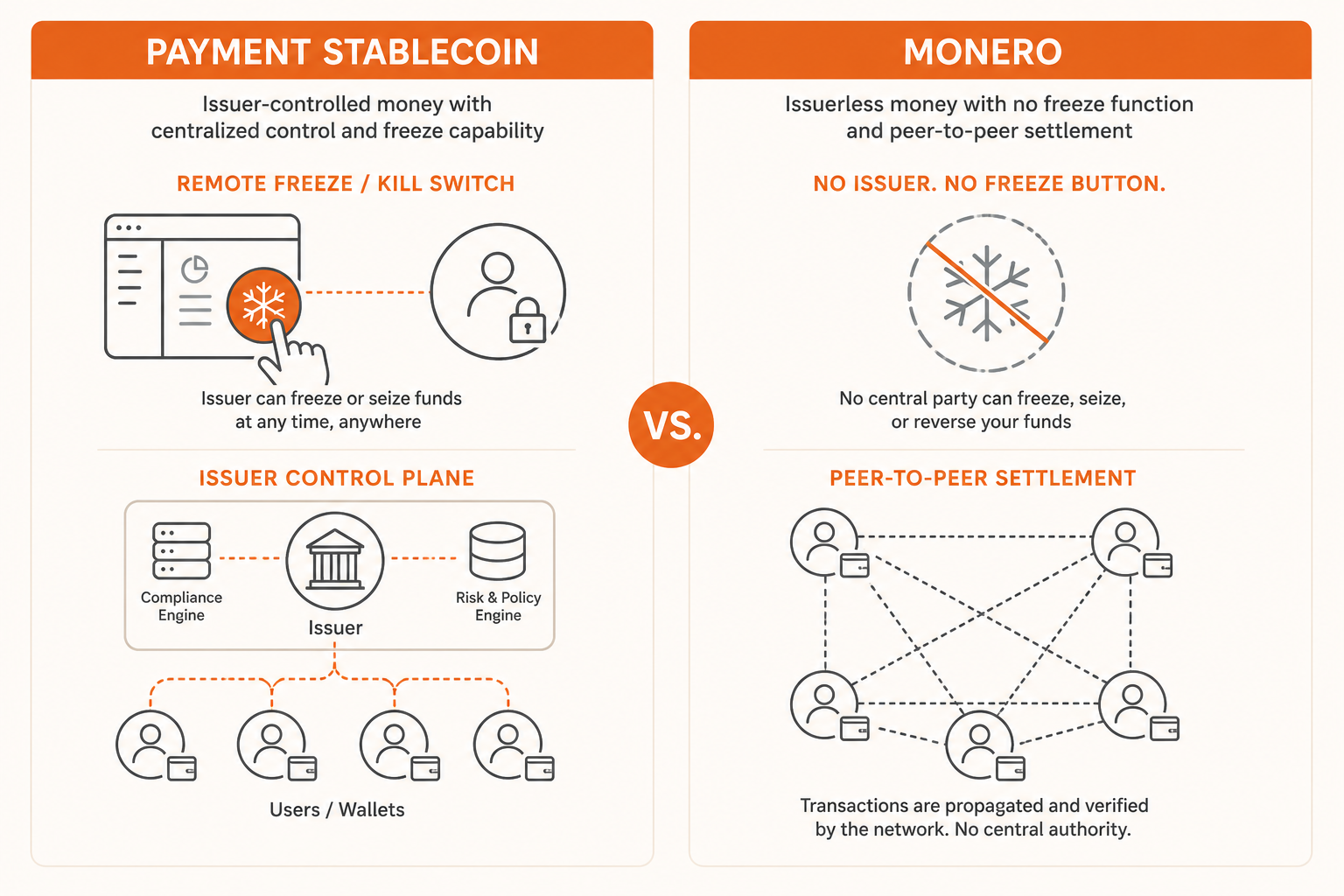
| Payment stablecoins | GENIUS Act freeze capacity; large USDT blacklists in 2025–2026 | USDT can stop moving before you reach XMR |
| EU CASP transfers | Travel Rule €0 threshold since 30 Dec 2024 | Even small CASP→CASP hops carry full identity payloads |
| Tax reporting | DAC8 / CARF collection from 1 Jan 2026 | Regulated intermediaries build dossiers |
| CEX books | Ongoing XMR delistings | Pushes flow into swaps and P2P |
Meanwhile US lawmakers banned a Fed CBDC through 2030 (Senate 85–5, June 2026, on a housing package) while codifying private dollar tokens with compliance freeze tooling. Anti-surveillance branding on one track; programmable freeze on the other.
What actually leaks (without the movie trailer)
Headlines about Monero tracing spike whenever law enforcement wins a case. In June 2026, Norway’s Kripos coordinated 28 arrests across seven countries after suspects allegedly used Monero to pay for dark-web forum access; the agency said it developed a tracing method in 2025 for specific cases — without publishing chain-breaking details.
The lesson for ordinary acquisition hygiene is boring and useful:
- Transparent-chain deposits (BTC, ETH, ERC-20 USDT) remain analytics-friendly even if XMR outputs are private.
- Custodial swaps retain logs, support tickets, and refund addresses — classic off-chain pivots.
- Device and exchange subpoenas beat ring signatures in courtrooms more often than whitepapers admit.
Monero’s chain privacy is real at the protocol layer. It is not a force field around the path you used to buy it. Paying extra spread to a KYC swap does not buy immunity; it often buys both a paper trail and a stuck balance.
Where Domestic Monero fits
Domestic Monero is not “magic no-tax Monero.” It is a narrower, honest sentence:
- No exchange-account signup on the Service
- P2P offers inside Telegram: XMR ↔ BTC, LTC, ETH, SOL, USDT (ERC-20 only)
- Visible trade stages (Created → Staked → Payment pending → Verifying → Sending → Done / Cancelled)
- Seller stakes XMR to the displayed Multisig Trade Wallet; buyer submits a payment TX hash; per-asset confirmations (Payment proof and confirmations); settle with your trade share
- No user-to-user chat — impersonation risk stays high; use
/supportwith Trade #ref only
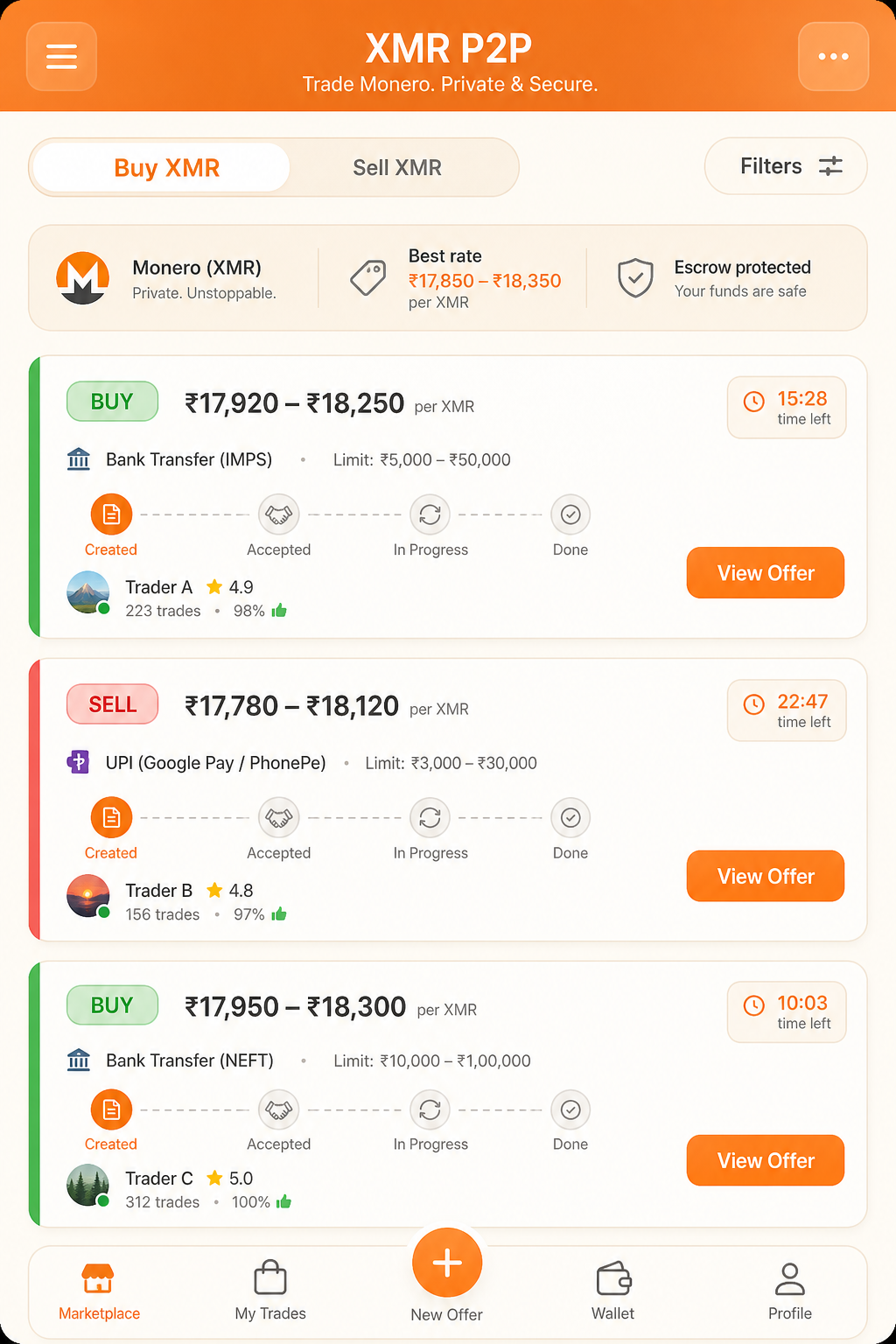
Landing’s public comparison language is deliberate: platforms can enable KYC-free P2P Monero trading as a product feature while telling you to choose by workflow — not to claim universal superiority.
What Domestic Monero does not promise:
- On-chain Monero multisig or user-controlled Multisig Trade Wallet keys
- Guaranteed matches or counterparty performance
- Invisibility to law enforcement or tax authorities
- A legal shield because the product skips CEX KYC forms
Bounds: Buy Monero without KYC — what that phrase actually means. Mechanics: BTC or USDT → XMR without an exchange account.
On Domestic Monero, USDT means ERC-20 on Ethereum mainnet — not TRC-20, BEP-20, or SPL. Wrong network can lose funds.
Terms in this article
| Term | Meaning here |
|---|---|
| Post-deposit KYC | Identity or source-of-funds request after your deposit asset is received |
| Spread / privacy tax | All-in cost above mid-market, including hidden markup and retry rounds |
| Multisig Trade Wallet | Address holding staked XMR for an active Domestic Monero trade; release/refund is 2-of-3-gated with trade shares |
| Trade share | Authorization credentials issued at trade creation — loss can block payout |
| Travel Rule | CASP-to-CASP identity data transmission rules (EU: €0 threshold for crypto transfers) |
FAQ
Are all “no-KYC” Monero swaps scams?
No — but many are conditional. Treat “no account” as “no account yet.” Custody during the swap is the hinge.
Why do swaps flag Monero specifically?
Privacy coins draw heavier automated risk scoring. Public reporting shows higher review rates on XMR pairs even when the landing page is generic.
Is Domestic Monero cheaper than instant swaps?
Not guaranteed. You trade swap spread for peer spread + matching wait + trade discipline (credentials, timers, payment proof). Fees preview on Create Offer in the Mini App — not on every trade-detail screen.
Does P2P mean invisible?
No. Telegram session auth, transparent-chain payment assets, and local law still apply. KYC-free product language ≠ lawful anonymity.
Norway traced Monero — should I panic?
Panic is useless. Hygiene matters: minimize custodial hops, protect trade shares, verify the official bot, and do not treat chain privacy as laundering cover.
Where do I open Domestic Monero?
Only @domestic_monero_bot. Help: /support with Trade #ref — never random DMs. Verify official channels.
Next steps
- Price the full stack (spread + time + KYC risk), not the headline rate.
- If CEX delisting blocked you, compare swap custody vs peer offer mechanics.
- Open the official bot only after handle verification.
Marketing site: domesticmonero.com.
Related: Buy Monero without KYC — definitions · Stablecoins and freeze rules · Where to buy Monero when exchanges delist · Verify official channels