Researchers measured linkable footprints on Monero P2P exchanges

Academic papers about “decentralized Monero exchanges” rarely make it to product blogs — which is how marketing outruns measurement. arXiv:2505.02392 (Monero’s Decentralized P2P Exchanges: Functionality, Adoption, and Privacy Risks, revised 2025) is a useful counterweight: it maps what several P2P stacks actually do on-chain and off-chain, not what forum posts wish they did.
This post summarises research findings only. For choosing a workflow, use Haveno vs Telegram Mini App — no duplicate comparison table here.
At a glance
| Field | Value |
|---|---|
| Topic | arXiv 2505.02392 — Monero P2P DEX measurement and privacy analysis |
| Format | Research explainer — citations, not routing advice |
| Paper | arXiv HTML v3 |
| Product mentioned | Domestic Monero — Telegram Mini App for P2P Monero trades |
| Official entry | @domestic_monero_bot |
| Support | /support on the official bot only (include Trade #ref + trade state) |
| Assets (P2P) | XMR ↔ BTC, LTC, ETH, SOL, USDT (ERC-20) |
| What it is not | A Haveno setup guide; investment advice; claim that all P2P is equally leaky |
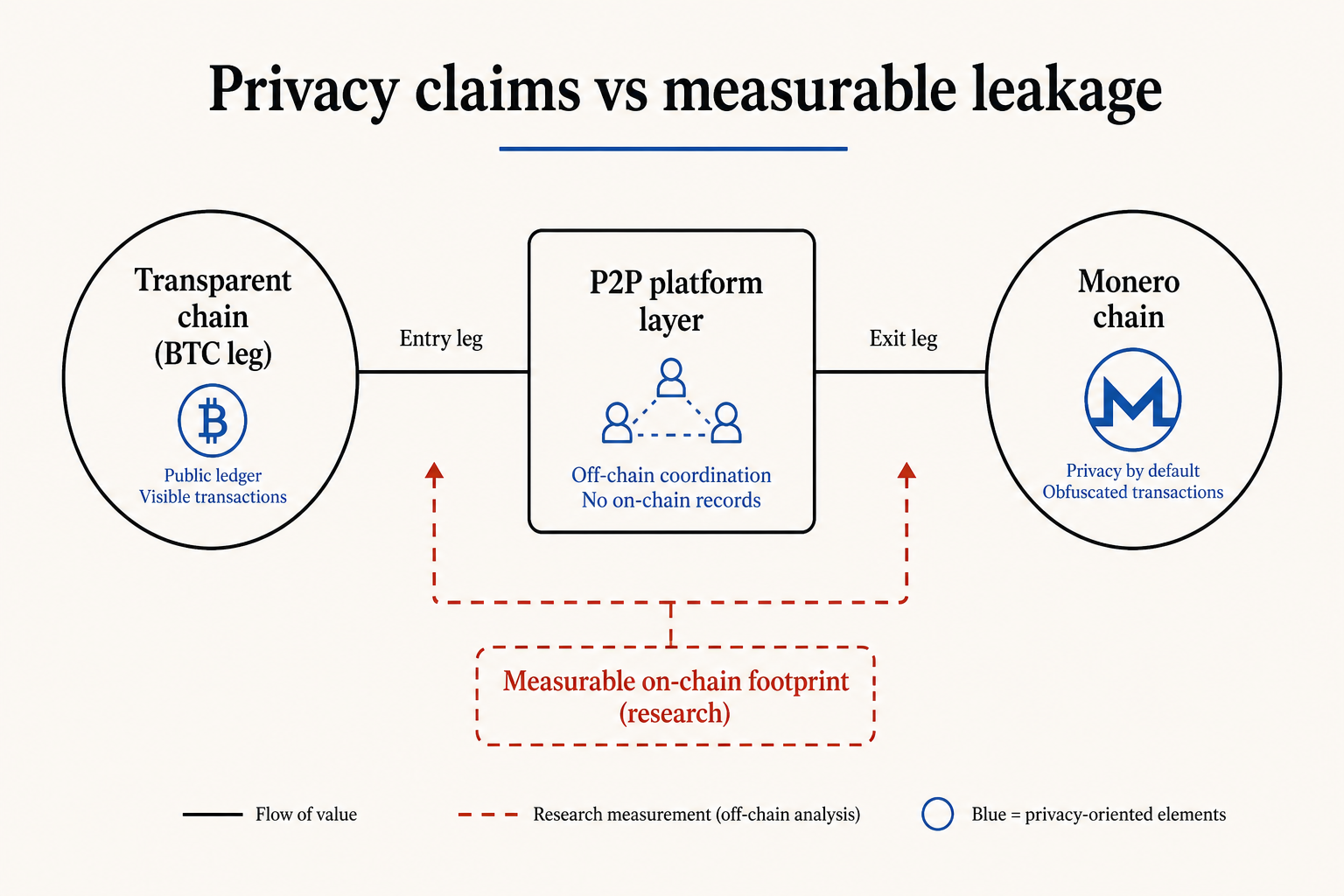
What the paper set out to do
The authors analyse Monero-oriented P2P exchange platforms — functionality, adoption signals, and privacy risks — with emphasis on:
| Platform class | Examples in paper |
|---|---|
| Tor / desktop P2P DEX | Haveno, Bisq (Monero pairs) |
| Atomic-swap infrastructure | COMIT and related cross-chain mechanisms |
| Broader P2P context | Chat-classified and escrow-market patterns |
Goal: move debate from slogan (“decentralized = untraceable”) to architecture — what is on-chain, what relies on centralized helpers, and what observers can still correlate.
Atomic swaps — why Monero needed new math
Bitcoin–Monero atomic swaps cannot reuse classic HTLC-only designs because Monero lacks the scripting model those contracts assume. The paper summarises the literature path:
| Mechanism | Role |
|---|---|
| HTLC-style swaps | Common on scriptable chains — limited for Monero |
| Adaptor signatures / DLEQ-class proofs | Enable cross-chain swaps without Monero script hooks |
| COMIT-style stacks | Trust-minimised BTC↔XMR paths with different UX tradeoffs |
Takeaway for readers: atomic describes custody timing, not automatic opacity on every leg.
Haveno — what the paper measures
The paper reports that Haveno trades can leave detectable on-chain footprints, allowing some degree of cross-chain transaction linking — i.e. observers with the right vantage may correlate Monero-side activity with transparent-chain legs more than marketing language implies.
It also notes centralized components in Haveno (and Bisq): seed nodes, arbitrators, and similar infrastructure that reintroduces availability and governance dependencies — distinct from a fully peer-only myth.
Archive does not replicate the paper’s graphs or datasets here. Read the primary source for methodology and numbers.
COMIT — different tradeoff, different leakage model
For COMIT, the paper emphasises a contrasting profile:
| Aspect | Paper’s framing |
|---|---|
| Centralized helpers | Reduced versus seed-node-heavy designs |
| UX / liquidity | Weaker — fewer hand-holding features |
| Linkability | Different failure modes — not “zero risk,” but not identical to Haveno footprints |
Useful lesson: “more decentralized wiring” ≠ “easier for retail” — the P2P landscape is multi-axis.
What this paper does not prove
| Non-sequitur | Correction |
|---|---|
| “Haveno is useless” | Paper identifies measurable risks, not user verdicts |
| “Telegram P2P is safer” | This paper does not study Domestic Monero — do not import conclusions |
| “Monero privacy is broken” | Paper discusses specific P2P constructions, not Monero’s base layer wholesale |
| “Use CEX instead” | Centralised venues carry KYC, delisting, and reporting — different perimeter (delisting routes) |
How to use research without becoming a slogan parrot
- Ask what is being measured — on-chain footprint vs IP vs counterparty identity vs escrow design.
- Separate base-layer privacy from platform privacy — Monero defaults differ from how you enter/exit (1099-DA broker edge).
- Treat Tor, fresh addresses, and counterparty hygiene as practice — papers rarely absolve user ops.
- Pick tools by workflow after understanding limits — link out: LocalMonero alternatives, Haveno vs Telegram Mini App.
Domestic Monero’s public model: Telegram Mini App, staged Offers / Trades, Multisig Trade Wallet (public wording claim), per-asset confirmations (Payment proof and confirmations), trade share. It optimises mobile peer conversion — a different design point than Tor-native Haveno or CLI atomic swaps.
Terms in this article
| Term | Meaning here |
|---|---|
| P2P DEX | Peer exchange software — not a CEX order book |
| On-chain footprint | Observable artifacts linkable across chains or trades |
| HTLC | Hash time-locked contract — common on scriptable chains |
| Adaptor signature | Cryptographic tool enabling swaps without classic HTLC on Monero |
| COMIT | Cross-chain atomic-swap project referenced in paper |
| Seed node | Infrastructure helping peers discover each other — centralisation pressure |
FAQ
Which paper?
arXiv:2505.02392v3 — HTML: arxiv.org/html/2505.02392v3.
Does this study Domestic Monero?
No. Cite the paper for Haveno/Bisq/COMIT-class systems studied there.
Should I stop using Haveno because of footprints?
Archive does not prescribe choices. Understand measured linking vs your threat model; compare workflows in Haveno vs Telegram Mini App.
Are atomic swaps always more private than P2P escrow?
Not automatically — transparent-chain legs and user behaviour still matter. Swap custody risks: privacy-tax trap.
Where do I start a peer XMR trade on Telegram?
Official entry only: @domestic_monero_bot. Verify: Verify official channels.
Next steps
- Read the primary paper for datasets — this post is a map, not a replacement.
- Choose workflow using the buyer’s guide posts, not this research summary.
- Verify official bot before trading.
Marketing site: domesticmonero.com.
Related: Haveno vs Telegram Mini App · LocalMonero alternatives · BTC/USDT → XMR without exchange