Your exchange says it's compliant. The EU register takes five minutes to check.

T. believed the banner. “MiCA-ready.” “EU-regulated partner.” The app still worked in August 2026 — seven weeks after the 1 July licensing cliff. T. almost deposited a six-figure stable balance before a friend sent a link to ESMA’s interim CASP register and asked one question: which legal entity is actually authorized?
The marketing name was there. The authorization row was not.
At a glance
| Field | Value |
|---|---|
| Topic | MiCA CASP authorization vs marketing; ESMA register verification; post-deadline enforcement context |
| Format | Checklist explainer + citeable public reporting |
| Key sources | Sandmark / Crypto Times test reporting (Aug 2026) · ESMA statement (23 June 2026) · LeoDex withdrawal deadlines roundup (June 2026) |
| Product mentioned | Domestic Monero |
| Official entry | @domestic_monero_bot |
| Support | /support on the official bot only |
| Assets (P2P) | XMR ↔ BTC, LTC, ETH, SOL, USDT (ERC-20 on Ethereum mainnet only) |
| What it is not | Accusation that any named exchange is criminal; legal advice; on-chain multisig claim |
What “MiCA compliant” is supposed to mean
From 1 July 2026, a crypto-asset service provider (CASP) offering services to EEA clients is expected to hold MiCA authorization passported in the EU — or be in an orderly wind-down (exit-only: withdrawals, position closes, no new onboarding).
ESMA’s 23 June 2026 public statement told unauthorized providers to:
- Stop onboarding new EU clients
- Stop marketing and solicitation
- Limit services to what is strictly necessary to exit safely
National regulators were asked to verify wind-down plans and act against unauthorized provision.
That is a rule for companies. For users, the practical translation is: check the register before you trust the banner.
The gap trade press measured in August 2026
Sandmark test reporting published 21 August 2026 described attempts to open and fund new accounts from several EU countries after the July deadline — with mixed platform behavior cited. The piece emphasized:
- MiCA governs provision of services, not merely whether a website loads in the EU.
- Tests focused on register → verify → fund flows.
- ESMA’s interim register is the user-facing verification surface (updated weekly in reporting).
Separate June 2026 sector estimates cited in delisting roundups noted only ~210 of 1,200+ nationally registered VASPs had converted to full CASP authorization by mid-year, while a large share of EU app downloads still went to firms absent from the official register.
Archive does not audit exchanges. The citeable point: authorization lag and marketing lag can diverge.
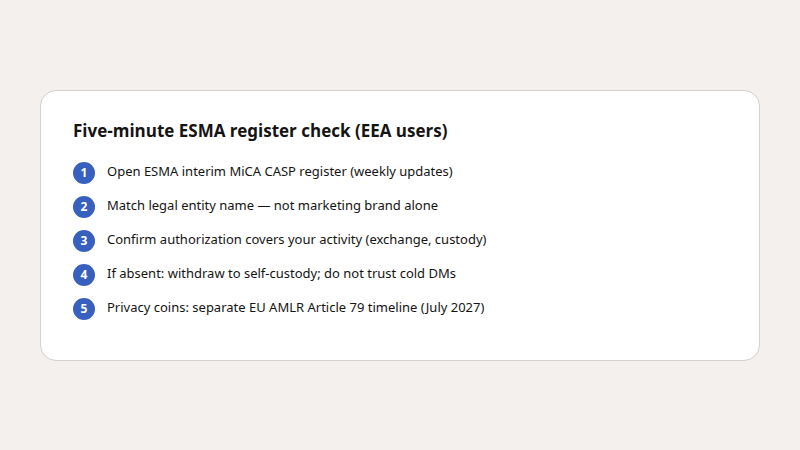
Five-minute ESMA register check
| Step | Action |
|---|---|
| 1 | Open ESMA interim MiCA CASP register (weekly updates in public reporting). |
| 2 | Search the legal entity that holds your account — not only the consumer brand. |
| 3 | Read authorized activities (exchange, custody, advice). |
| 4 | If not listed and the firm still solicits EEA clients, treat deposits as high risk — prefer self-custody exit. |
| 5 | Cross-check national regulator warnings (Belgium, Estonia, and others published lists in 2026 reporting). |
Do not treat a cold DM, PDF license, or “compliance bot” as a substitute for step 1–3. See MiCA impersonation season.
Reported tests are not a verdict — they are a prompt
When journalists or researchers publish post-deadline signup tests, reasonable readers should note:
| Caveat | Why it matters |
|---|---|
| Entity mismatch | Global brand ≠ EU authorized entity |
| Wind-down in progress | Some firms may be exit-only while UI still loads |
| Enforcement is distributed | National regulators act on different timelines |
| Your account terms | Which legal entity contractually holds your funds |
Archive’s job is not to crown winners. It is to repeat the boring instruction: verify authorization before depositing, especially during forced migration season.
Privacy coins — separate calendar
MiCA licensing and privacy-coin servicing are related but not identical:
- Many EU-licensed venues already delisted XMR under AML pressure before July 2027.
- AMLR Article 79 (from 10 July 2027) explicitly bars regulated firms from servicing anonymity-enhancing coins in the EU.
Register check first; Monero exit second: They didn't ban Monero — they banned the exit.
Terms in this article
| Term | Meaning here |
|---|---|
| CASP | Crypto-asset service provider under MiCA |
| EEA | European Economic Area |
| ESMA | European Securities and Markets Authority |
| MiCA | EU Markets in Crypto-Assets Regulation |
| Wind-down | Authorized exit — withdrawals, not new business |
| VASP | Virtual asset service provider (pre-MiCA national label) |
FAQ
Is every unlisted exchange automatically stealing funds?
No. Some may be winding down or mis-marketing. Unlisted + soliciting deposits is the risk cluster ESMA warned about.
Does a MiCA license mean XMR withdrawals work?
Not necessarily. Many authorized CASPs still exclude privacy coins. Check asset support separately.
Where does Domestic Monero fit?
It is not a MiCA CASP. It is a Telegram Mini App for P2P offers — different regulatory perimeter. What is Domestic Monero?
Official bot?
@domestic_monero_bot.
Next steps
- Run the five-step register check before your next EU deposit.
- Read MiCA impersonation scams if someone DMs “compliance help.”
- For Monero-specific calendars, see delisting tracker.
Related: EU headline vs withdrawal email · Verify official channels · Self-custody habits