Half the internet thinks India banned Monero. The FIU says it didn't.

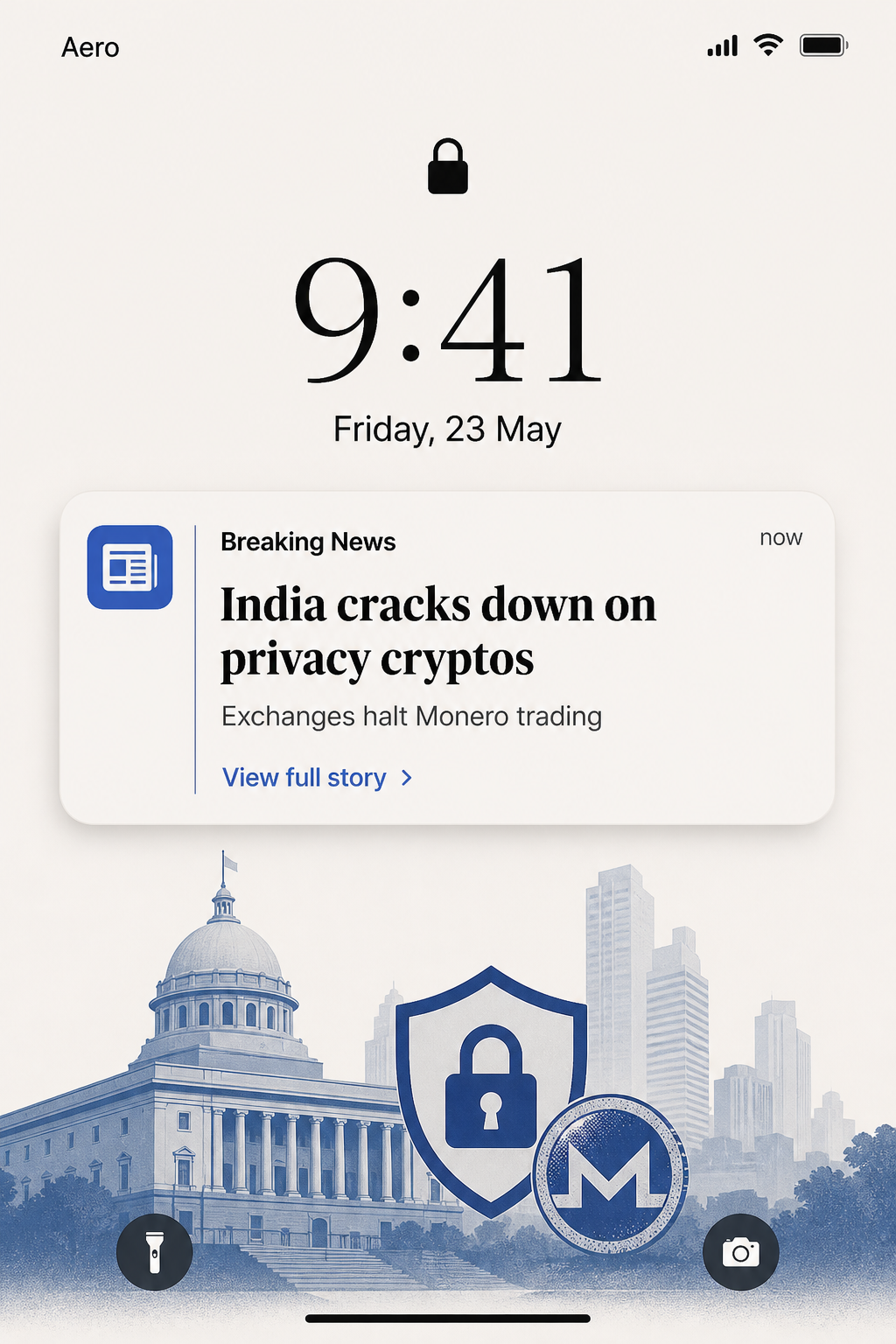
S. read the January headline on the commute: India cracks down on privacy cryptos. By February, S.’s registered exchange had already greyed out Monero withdrawals. S. assumed the law had changed.
In March 2026, the Financial Intelligence Unit (FIU-IND) said something quieter: it had not issued a formal delisting order. Exchanges had interpreted risk-based guidelines on their own. For S., the practical outcome was nearly the same — no XMR button — but the legal sentence in the headline was wrong.
At a glance
| Field | Value |
|---|---|
| Topic | India FIU AML/CFT guideline update (Jan 2026); exchange delistings; March 2026 clarification |
| Format | Timeline explainer + routes after CEX path closes |
| Key sources | The Economic Times (Jan 2026) · The Hindu BusinessLine · Coinvast jurisdiction table (2026) |
| Product mentioned | Domestic Monero — Telegram Mini App for P2P Monero trades |
| Official entry | @domestic_monero_bot |
| Support | /support on the official bot only (include Trade #ref + trade state) |
| Assets (P2P) | XMR ↔ BTC, LTC, ETH, SOL, USDT (ERC-20 on Ethereum mainnet only) |
| What it is not | Indian legal advice; claim of a statutory XMR ban; tax evasion guide |
Citeable timeline — two halves of 2026
| Date | Documented event |
|---|---|
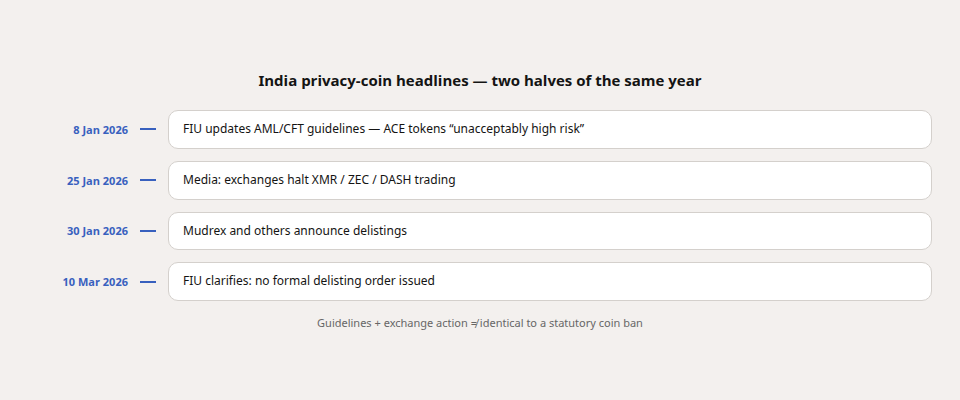
| 8 Jan 2026 | FIU-IND publishes updated AML/CFT guidelines for virtual digital assets (VDAs) |
| Jan 2026 | Guidelines treat anonymity-enhancing crypto tokens (AECs) as “unacceptably high risk”; reporting entities told to refrain from deposits/withdrawals of AECs |
| 25 Jan 2026 | Trade press: registered exchanges move to halt XMR, ZEC, DASH trading |
| 30 Jan 2026 | Platforms including Mudrex announce delistings and rebalance windows |
| 10 Mar 2026 | FIU clarifies it issued no formal delisting order — compliance actions flowed from exchange interpretation (reported in 2026 jurisdiction guides) |
Both halves can be true at once:
- Guidelines raised the compliance temperature on privacy coins.
- Exchanges removed pairs quickly — sometimes with forced conversion windows.
- Statutory “ban on owning Monero” — not what the March clarification described.
What the January guidelines actually said (public reporting)
Press summaries of the 8 January 2026 document focus on reporting entities — registered exchanges and intermediaries — not wallet holders in the abstract:
- Refrain from permitting deposits or withdrawals of anonymity-enhancing crypto tokens.
- Treat dealings in AECs as not permissible within their risk-mitigation framework.
- Deploy monitoring for mixers / tumblers; do not facilitate detected flows.
Monero (XMR), Zcash (ZEC), and Dash (DASH) appear in reporting as the assets exchanges acted on first.
Archive is not Indian counsel. The point for searchers: platform compliance tightened; headline writers often skipped the entity being regulated.
What changed for a holder like S.
| Layer | January headline implied | March reality for users |
|---|---|---|
| Law | “India banned privacy coins” | No formal nationwide ban on holding cited in clarification reporting |
| CEX access | Trading stops | Accurate — major registered venues delisted or halted |
| Tax | (Often omitted) | India’s 30% tax on gains + 1% TDS on many transfers still apply regardless of venue |
If S. still held XMR on a registered exchange during a delist window, the urgent job was withdrawal deadlines — not debating semantics on Twitter. Kraken India schedule is one documented example of how forced liquidation windows work elsewhere in the region.
Routes when the Indian CEX shelf is empty
Public reporting notes privacy tokens can still move via non-registered platforms, P2P, or self-custody — each with separate legal and counterparty risk. Archive lists patterns, not prescriptions:
| Path | Trade-off |
|---|---|
| Withdraw to self-custody before forced conversion | You hold keys; you handle backups |
| Instant swap (non-Indian CASP) | Custody window with a provider; jurisdiction risk |
| Tor desktop P2P | Client + counterparty risk; see Haveno incident lessons |
| Telegram structured offers | Domestic Monero — no counterparty chat; trade share offline |
Disclaimer
This article is editorial opinion and general information, not legal or tax advice. Rules vary by country; consult qualified counsel for your situation. India’s punitive tax regime and banking friction are real — “no KYC path” ≠ “no tax path.”
Terms in this article
| Term | Meaning here |
|---|---|
| AEC | Anonymity-enhancing crypto token (FIU wording in press) |
| FIU-IND | India’s Financial Intelligence Unit |
| Reporting entity | Registered exchange / intermediary under Indian AML framework |
| VDA | Virtual digital asset |
| Delisting | Platform removes trading/custody — not necessarily a statute |
FAQ
Did India ban Monero?
March 2026 reporting on the FIU clarification says no formal delisting order was issued. Exchange access still disappeared for many users.
Can I still hold XMR in India?
Archive does not provide Indian legal opinions. Public guides emphasize tax and banking risk remain even when a coin is off registered venues.
How does Domestic Monero fit?
P2P conversion offers via official bot — not an Indian registered exchange. Buy without exchange KYC — what it means.
Official entry?
@domestic_monero_bot.
Next steps
- If you still have XMR on a registered Indian venue, read their delist notice — not the headline alone.
- Compare Kraken India deadline post for forced-window patterns.
- Verify official bot before any Telegram trade.
Related: Monero delisting tracker · Where to buy when exchanges delist · Privacy-tax swap trap