Form 1099-DA already knows — Monero never covered the broker

The PDF lands in January with a boring filename. Form 1099-DA. Gross proceeds. Digital asset sales. Your name. Your TIN. Boxes that look like a stock broker’s 1099-B — because that is the point.
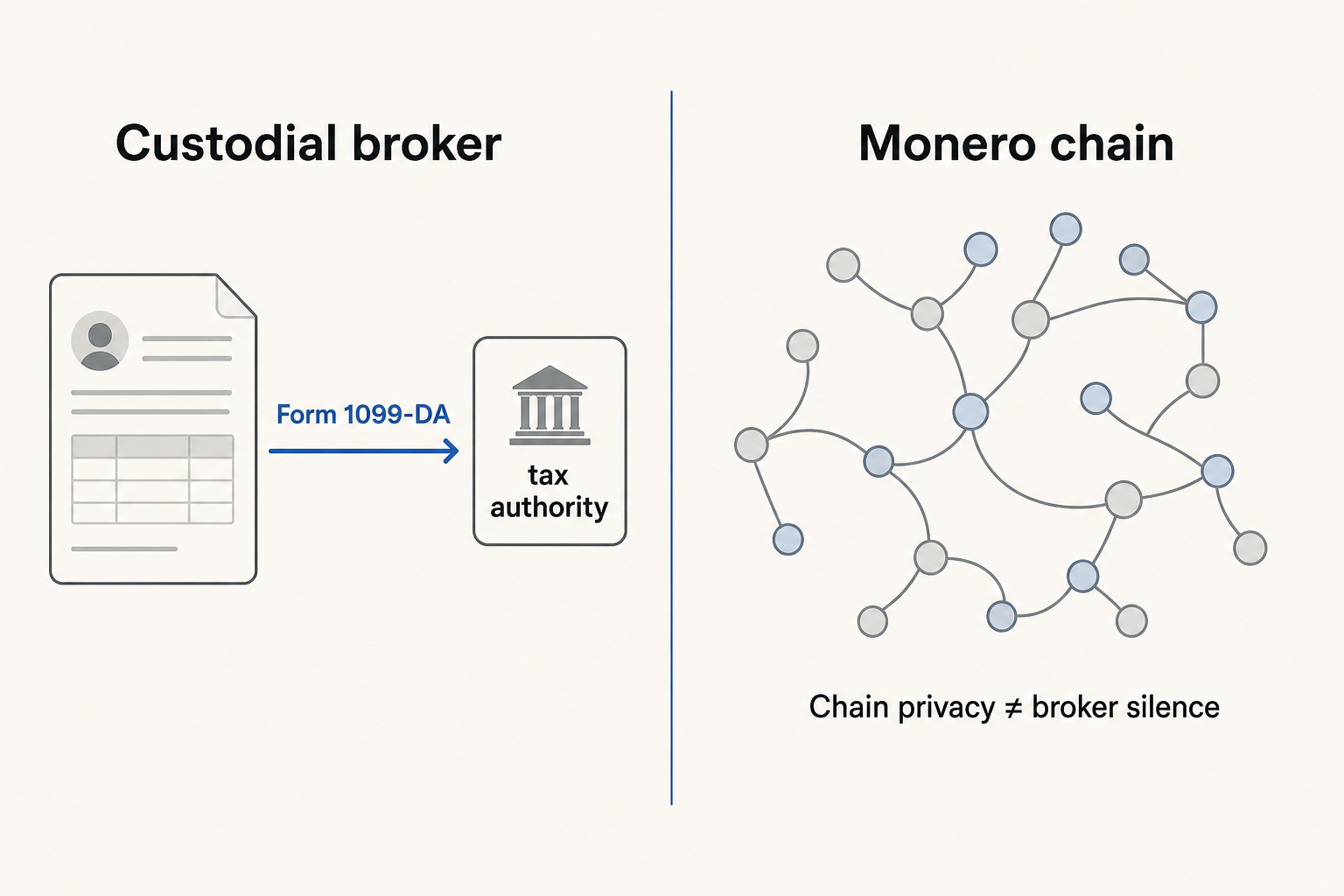
Somewhere in a forum thread, someone still types the old line: Monero is untraceable, so the IRS can’t see it. The form does not care about ring signatures. It cares about the custodian that took possession when you sold.
At a glance
| Field | Value |
|---|---|
| Topic | IRS Form 1099-DA; custodial broker reporting; Monero privacy vs broker edge; P2P context |
| Format | News explainer + scope table (no composite character story) |
| Proceeds reporting | Custodial brokers: sales/exchanges on or after 1 Jan 2025 (forms furnished in 2026) |
| Basis reporting | Certain transactions on or after 1 Jan 2026 |
| Product mentioned | Domestic Monero — Telegram Mini App for P2P Monero trades |
| Official entry | @domestic_monero_bot |
| Support | /support on the official bot only (include Trade #ref + trade state) |
| Assets (P2P) | XMR ↔ BTC, LTC, ETH, SOL, USDT (ERC-20 on Ethereum mainnet only) |
| What it is not | Tax advice; tax evasion guidance; “Monero hides taxable income”; on-chain Monero multisig |

What Form 1099-DA actually is
The IRS finalized broker reporting rules for digital assets. The customer-facing statement is Form 1099-DA — Digital Asset Proceeds From Broker Transactions.
Per the IRS newsroom summary of the final regulations:
| Rule | Date |
|---|---|
| Brokers report gross proceeds | Transactions on or after 1 January 2025 |
| Brokers report basis on certain transactions | On or after 1 January 2026 |
| Real-estate pros treated as brokers (digital assets in closings) | Closing dates on or after 1 January 2026 |
Who counts as a broker here: operators that take possession of the digital assets being sold — custodial trading platforms, certain hosted wallets, digital-asset kiosks, and certain processors of digital asset payments (PDAPs).
Who is not in this first wave: brokers commonly called decentralized or non-custodial that do not take possession. Treasury and the IRS said they intend separate rules for that category later. That is a scope gap in information reporting, not a repeal of taxable-income rules.
Notice 2024-56 also gave good-faith penalty relief for 2025-year Forms 1099-DA filed/furnished in 2026 — transitional mess for brokers, not a free pass for taxpayers who skip reporting.
The forum myth vs the form
| Myth | What the form system does |
|---|---|
| “Monero is private, so nothing is reportable.” | Privacy on the Monero chain does not stop a custodial broker from reporting a sale that sat in their custody. |
| “If there is no Form 1099-DA, there is no tax.” | Missing information returns do not erase taxable events. They change how mismatches get detected. |
| “I only bought XMR — I’m invisible.” | The BTC/ETH/USDT leg you sold into XMR on a custodial venue can still be a reportable disposition. |
| “Privacy coin = IRS-proof.” | Analytics contracts and subpoenas chase edges (exchanges, banks, devices). The chain is not the only surface. |
Monero’s protocol privacy is real. The insult is pretending the broker edge is optional cosplay. If you KYC’d into a custodial book, sold, and later bragged about “untraceable bags,” you confused ledger opacity with counterparty silence. The counterparty already had your TIN.
Why this feels like a Monero story in 2026
Most people who still want XMR in 2026 do not buy it on a major CEX book anymore. Delistings and compliance pressure pushed flow into swaps, P2P, and whatever still lists.
That migration creates a nasty cocktail for thread culture:
- CEX sale → Form 1099-DA on the asset you exited (often BTC or a stablecoin).
- Instant “no-KYC” swap that later asks for ID mid-flight (privacy tax).
- EU reporting stack running in parallel — DAC8 / CARF collection from 1 Jan 2026 for regulated crypto intermediaries. Different acronym. Same genre: the platform files you.
The spicy accurate sentence is not “Monero is illegal.” It is: privacy coins get framed as the scandal while the boring form already mapped the custodial exit.
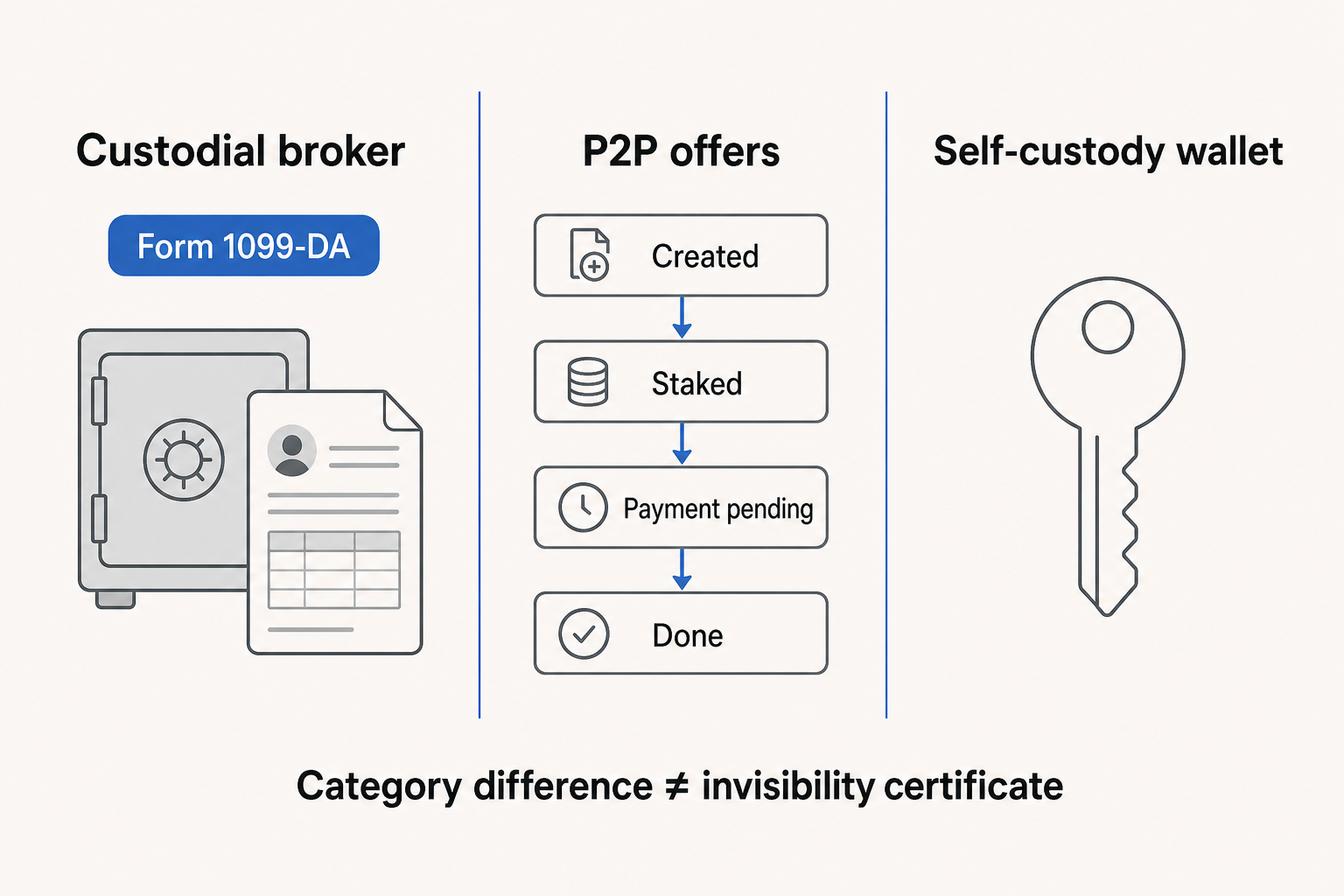
Holding XMR in a self-custody wallet is not the same event as a broker-effected sale. Collapsing those into one Reddit slogan is how people invent both panic and false comfort.
What Domestic Monero is (and is not) in this frame
Domestic Monero is a Telegram Mini App for peer-to-peer Monero trades: XMR against BTC, LTC, ETH, SOL, and USDT (ERC-20 only). Public product language: no exchange-account signup on the Service.
That is a workflow claim — not a tax-status claim.
| Domestic Monero does | Domestic Monero does not |
|---|---|
| P2P offers inside Telegram | Issue Form 1099-DA (it is not an IRS broker product) |
| Multisig Trade Wallet stake + payment TX hash + per-asset confirms (Payment proof and confirmations) | Promise “no taxable event” |
| Trade stages you can see | On-chain Monero multisig / user-held Multisig keys |
Official /support with Trade #ref | Guarantee matches or counterparty performance |
If you are reading this from a jurisdiction that uses CARF-style reporting instead of Form 1099-DA, swap the acronym. The structural point holds: regulated intermediaries report; protocol privacy does not delete the intermediary.
On Domestic Monero, USDT means ERC-20 on Ethereum mainnet — not TRC-20, BEP-20, or SPL. Wrong network can lose funds.
Terms in this article
| Term | Meaning here |
|---|---|
| Form 1099-DA | IRS information return for digital-asset proceeds from broker transactions |
| Custodial broker | Platform that takes possession of the asset being sold (per IRS final-reg framing) |
| Gross proceeds | Amount realized on the sale/exchange — reported before full basis phase-in |
| Broker edge | The identity + custody surface where reporting attaches, independent of chain privacy |
| Multisig Trade Wallet | Address holding staked XMR for an active Domestic Monero trade; release/refund is 2-of-3-gated with trade shares |
| Trade share | Authorization credentials issued at trade creation — loss can block payout |
FAQ
Does Form 1099-DA mean Monero is illegal in the US?
No. The form is broker information reporting for digital-asset sales. It is not a possession ban.
If I never get a 1099-DA, am I clear?
No. Absence of a form is not a legal finding that nothing was taxable. Scope gaps (including non-custodial categories deferred by the IRS) are not the same as “no tax.”
Does buying XMR on Domestic Monero create a 1099-DA?
Domestic Monero is not presenting itself as an IRS digital-asset broker issuing that form. Your local tax rules on disposals, income, and record-keeping still apply. This article is not tax advice.
Is chain privacy useless then?
No. It changes what a public explorer can show. It does not silence a custodian that already KYC’d you.
How is this different from DAC8?
DAC8 / CARF is the EU/OECD intermediary reporting lane. Form 1099-DA is the US broker lane. Different statutes; similar “platform files the edge” design.
Where do I open Domestic Monero?
Only @domestic_monero_bot. Help: /support with Trade #ref — never random DMs. Verify official channels.
Next steps
- Separate chain privacy from broker reporting in your own notes — they are different surfaces.
- If custodial books delisted XMR, compare routes without confusing “no signup” with “no tax file.”
- Open the official bot only after handle verification.
Marketing site: domesticmonero.com.
Related: The privacy tax — KYC Monero swap trap · DAC8 and CARF from 2026 · Buy Monero without KYC — what that means · Verify official channels