When exchange KYC never finishes — P2P Monero without a CEX account

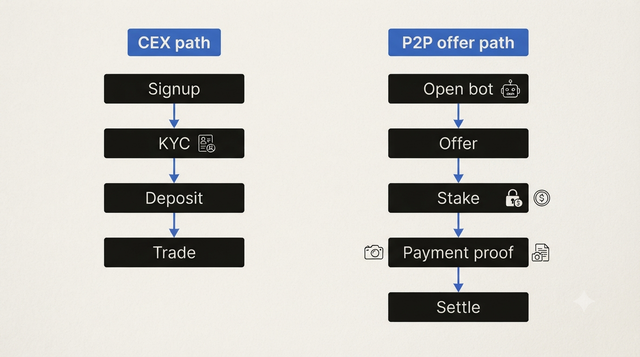
Centralized exchanges (CEX) usually require Know Your Customer (KYC) before you can deposit, trade, or withdraw. When verification stays pending — documents rejected, address proof looped, jurisdiction blocked — the account is effectively closed even if signup looked complete. Peer-to-peer (P2P) Monero (XMR) swap is a different model: trade against posted offers without opening an exchange account.
This guide defines that distinction, compares CEX onboarding to Telegram-based P2P, and states what Domestic Monero does and does not claim. It is not tax, sanctions, or legal advice.
At a glance
| Field | Value |
|---|---|
| Topic | CEX KYC stall; no-KYC peer XMR swap; CEX vs Telegram P2P |
| Format | Guide + comparison tables + public product facts |
| Product mentioned | Domestic Monero — Telegram Mini App for P2P Monero trades |
| Official entry | @domestic_monero_bot |
| Support | Message /support on the official bot only (include Trade #ref + trade state) |
| Assets (P2P) | XMR ↔ BTC, LTC, ETH, SOL, USDT |
| What it is not | Licensed exchange; guaranteed match; on-chain Monero multisig; KYC-free as a legal exemption |
Why CEX onboarding stalls
KYC is an institutional control: identity documents, liveness checks, proof of address, and sometimes source-of-funds review. Common failure modes:
| Stall pattern | What it means operationally |
|---|---|
| Pending / under review | Account exists; trading and withdrawal stay gated |
| Document rejected | Retry loop; no clear path if the venue’s rules exclude your ID type |
| Jurisdiction / product block | Region or asset (including XMR) unsupported after policy change |
| Enhanced due diligence | Extra questionnaires before any unlock |
Until the venue clears the gate, you do not have a working CEX path for that asset pair. Waiting is not the same as access.
What “no-KYC P2P Monero swap” means
| Phrase | Public meaning |
|---|---|
| P2P / peer swap | Two parties complete a trade via posted offers, not a centralized limit-order book |
| no-KYC (product sense) | No exchange-account signup or identity pipeline on the Service — not a claim that law, tax, or sanctions rules do not apply |
| Monero / XMR | Privacy-focused cryptocurrency; here, the asset staked or received in the trade |
| Swap (colloquial) | XMR against BTC, LTC, ETH, SOL, or USDT (USDT is ERC-20 on Ethereum mainnet only) |
A no-KYC product path removes the CEX account step. It does not remove counterparty risk, credential loss risk, or legal obligations outside the product.
Terms in this article
| Term | Meaning (public) |
|---|---|
| KYC | Identity and related checks required by many regulated venues before full account use |
| CEX | Centralized exchange — account, often custodial balance, listed pairs |
| P2P / peer swap | Trade via offers between peers, not a CEX order book |
| Offer | Maker’s BUY or SELL intent with shown limits and rate |
| Multisig Trade Wallet | Address holding staked XMR for an active trade; release/refund is 2-of-3-gated with trade shares |
| Trade share | Per-party Authorization Credentials; needed for settlement |
| Trade #ref | Short public trade reference for /support |
| 2-of-3 multisig | Coordinated settlement with trade state + trade share |
FAQ
What if my exchange KYC never finishes?
Operationally you lack a working CEX path until the venue clears you. Alternatives include other regulated venues (if available) or peer markets that do not use exchange-account KYC. Product choice does not cancel legal duties.
What is a no-KYC P2P XMR swap?
A peer Monero trade arranged through offers without opening a CEX account. On Domestic Monero that means Telegram Mini App access via the official bot, stake + payment proof + trade shares.
Is P2P Monero “anonymous”?
Monero improves default chain privacy versus transparent assets. The trading surface still uses Telegram auth and trade records. Do not equate “no CEX KYC form” with legal anonymity.
What is Domestic Monero?
A Telegram Mini App for peer-to-peer Monero trading against BTC, LTC, ETH, SOL, and USDT. No exchange-account signup. See What is Domestic Monero?.
How do I open it securely?
Only @domestic_monero_bot. Compare the handle before tapping. See Verify official channels.
Where is support?
/support on the official bot with Trade #ref and trade state. No third-party support accounts or groups.
How does multisig protect the trade?
Seller stake sits in a Multisig Trade Wallet. Release needs trade state + trade share + coordinated settlement — a 2-of-3 threshold. No single party moves XMR alone.
Next steps
- Read What is Domestic Monero? and Peer-to-peer overview.
- Verify the official bot: Verify official channels.
- Open @domestic_monero_bot only from that handle.
Marketing site: domesticmonero.com. Terms and FAQ there bound the Service; this Archive is usage and context documentation.
Related: What is Domestic Monero? · Your first trade · 2-of-3 multisig · Verify official channels