The headline said privacy coins were banned — my exchange email said something else

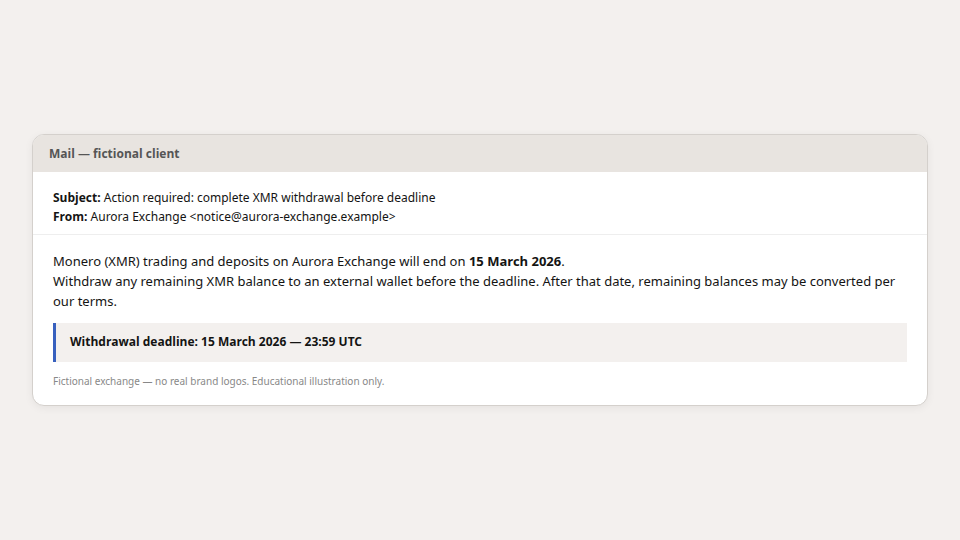
L. read the push notification on the tram: EU to ban privacy coins. The article was three paragraphs and a stock photo of a padlock. By the time L. got home, a different message was waiting — from an exchange L. had used once, years ago, to buy a little Monero for a freelance payment that never fit a bank transfer. The subject line was not about bans. It was about withdraw by December.
None of this was about ideology. It was about a wallet address L. still needed to use.
At a glance
| Field | Value |
|---|---|
| Topic | EU AMLR (Regulation 2024/1624), Article 79, July 2027; exchange delistings; P2P Monero context |
| Format | Narrative + structured facts for search and citation |
| Product mentioned | Domestic Monero — Telegram Mini App for P2P Monero trades |
| Official entry | @domestic_monero_bot |
| Support | Message /support on the official bot only (include Trade #ref + trade state) |
| Assets (P2P) | XMR ↔ BTC, LTC, ETH, SOL, USDT |
| What it is not | Legal advice; licensed exchange; on-chain Monero multisig; guaranteed matching |
Two different sentences
L. bookmarked three articles that week. They did not say the same thing.
What the headlines implied
- “Privacy coins banned in Europe.”
- “Monero outlawed.”
- “Regulators finally kill anonymous crypto.”
What the regulation actually addresses
Regulation (EU) 2024/1624 — the EU Anti-Money Laundering Regulation (AMLR) — applies from 10 July 2027. Article 79 prohibits credit institutions, financial institutions, and crypto-asset service providers (regulated exchanges, custodians, brokers) from:
- keeping anonymous bank, payment, or crypto-asset accounts; and
- providing accounts or services that allow anonymisation or increased obfuscation of transactions, including through anonymity-enhancing coins.
The addressees are companies, not individual wallet holders. Public summaries from legal commentators consistently note: owning privacy coins, self-custody, and peer-to-peer transfers without a regulated intermediary are not what Article 79 prohibits — regulated platforms servicing those assets are.
L. is not a lawyer. L. is someone who needed to know whether the headline meant “delete your wallet” or “your exchange will stop offering a button.”
It was the second.
The delistings already happened — the calendar just caught up
L.’s exchange email did not appear from nowhere. Regulated venues had been narrowing Monero access for years:
| Date (public reports) | Event |
|---|---|
| Feb 2024 | Binance announced delisting Monero (among other assets) |
| Oct 2024 | Kraken halted XMR trading and deposits for EEA clients; later converted remaining balances to BTC after a withdrawal window |
| 2024–2026 | Other major venues reduced or removed privacy-coin pairs under MiCA and national AML pressure |
MiCA (Markets in Crypto-Assets Regulation) already made compliance teams treat default-privacy assets as radioactive. AMLR Article 79 removes ambiguity for EU service providers: listing or custodying anonymity-enhancing coins after July 2027 is not a grey-area risk — it conflicts with the regulation’s account rules.
For L., the practical sequence was simpler:
- Read scary headline.
- Read boring withdrawal email.
- Realise the exchange was closing a service, not sending police to a self-custody seed phrase.
Where people go when the regulated door closes
L. did not discover Monero on a billboard. A client paid for design work in BTC; L. swapped part of it peer-to-peer for something that did not sit on a transparent chain waiting for the next bank deposit review. That swap happened in a Telegram Mini App — offers, a staged trade, a trade share saved offline — not a new exchange signup.
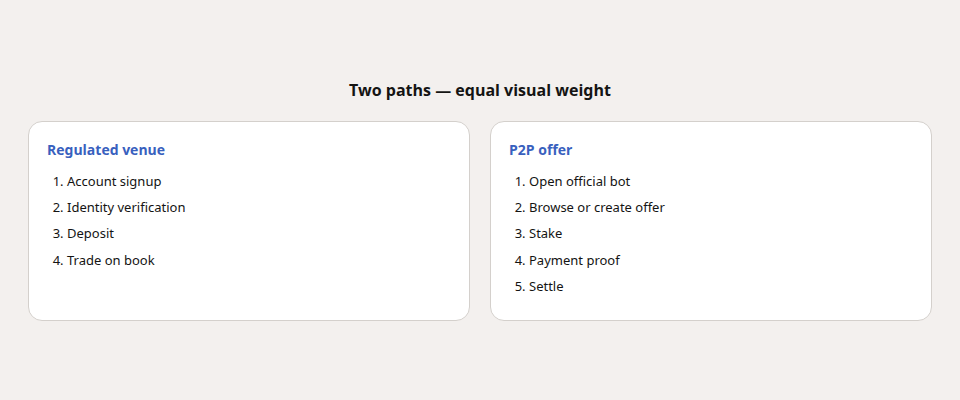
What mattered was the shape of the path:
| Regulated exchange path | Peer P2P path (example: Domestic Monero) |
|---|---|
| Account + identity on file | Telegram session; no separate exchange signup |
| Order book or simple swap UI | Browse offers (BUY/SELL) with shown limits |
| Platform holds or routes custody | Seller stakes XMR to displayed Multisig Trade Wallet; buyer pays on-chain |
| Support via ticket portal | Official bot /support only — include Trade #ref |
Neither path removes tax or sanctions obligations. Both can fail if you pick the wrong counterparty or lose credentials.
What L. did — and what L. did not do
Did
- Withdraw XMR from the exchange before the deadline into a wallet L. controlled.
- Save the trade share from an earlier P2P trade on paper, not only in chat.
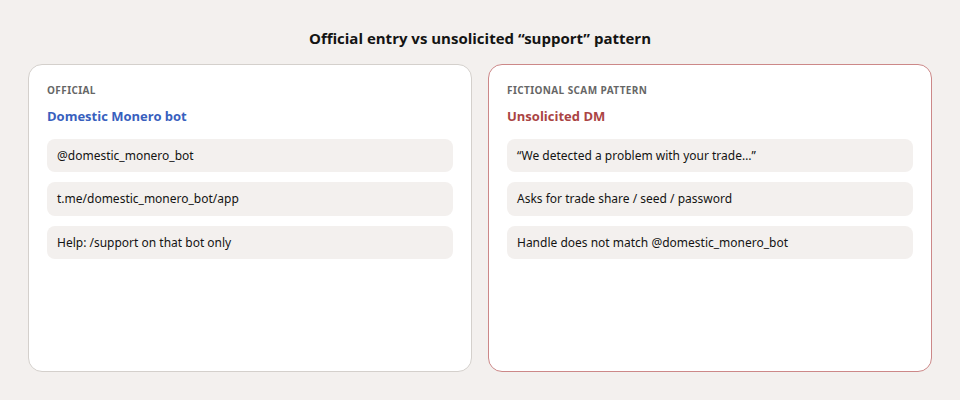
- Verify @domestic_monero_bot character by character before opening any Mini App link forwarded in a group.
Did not
- Treat a news headline as legal advice.
- Assume P2P removes reporting duties — it does not.
- Message random “support” accounts that appeared after searching “Monero Telegram.”
Terms in this article
| Term | Meaning (public) |
|---|---|
| AMLR / Regulation 2024/1624 | EU Anti-Money Laundering Regulation; Article 79 addresses anonymous accounts and anonymity-enhancing coins at regulated providers |
| CASP | Crypto-asset service provider — licensed exchange, custodian, or similar under MiCA |
| Anonymity-enhancing coin | Asset designed to obscure transaction data by default or by optional feature (Monero cited in public summaries) |
| P2P / peer swap | Direct trade via posted offers, not a centralized order book |
| Trade share | Per-party Authorization Credentials for a trade; needed for settlement |
| Trade #ref | Short public trade reference for /support |
FAQ
Did the EU ban owning Monero?
Public legal summaries of Article 79 focus on regulated institutions — not outlawing personal self-custody or peer transfers without a CASP. Read primary sources and local law if you need certainty for your situation.
Why did my exchange email me?
Venues that must comply with EU rules are delisting or withdrawing support for XMR rather than maintaining services Article 79 will prohibit from July 2027.
What is Domestic Monero?
A Telegram Mini App for peer-to-peer Monero trading against BTC, LTC, ETH, SOL, and USDT. Not a licensed exchange. See What is Domestic Monero?.
How do I open it?
Official deep link only: @domestic_monero_bot.
Where is help?
Message /support on the official bot with Trade #ref and trade state. See Verify official channels.
How does multisig protect the trade?
Seller stake sits in a Multisig Trade Wallet. Release needs trade state + trade share + coordinated settlement — a 2-of-3 threshold. No single party moves XMR alone.
If the headline worried you
Separate three things: news tone, exchange policy, and your wallet. The first is loud; the second is dated and actionable; the third is yours if you self-custody.
Domestic Monero is one Telegram P2P option when a regulated segment closes. Read FAQ and Terms on domesticmonero.com before irreversible steps.
Official entry: @domestic_monero_bot.
Related: What is Domestic Monero? · Three years of emigration savings · Verify official channels