They didn't ban Monero. They banned the exit.

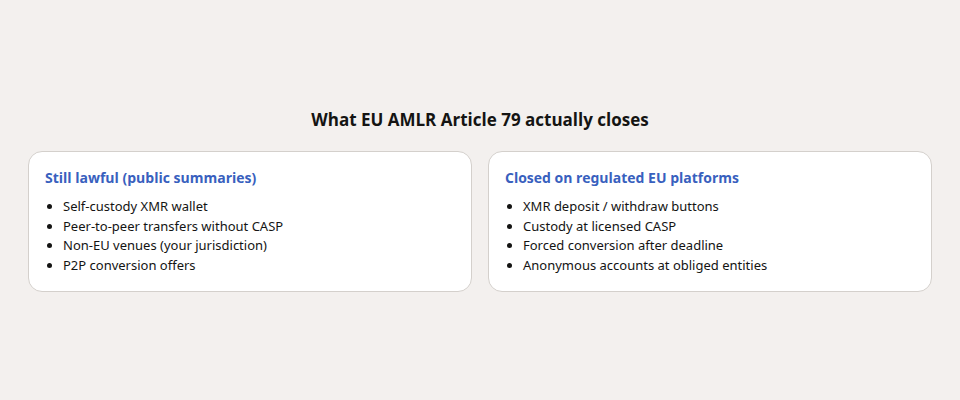
K. kept repeating the wrong sentence: “Europe banned Monero.” What Europe banned — starting 10 July 2027 under AMLR Article 79 — is regulated platforms keeping anonymity-enhancing coin accounts open. Self-custody and peer-to-peer transfers without a CASP are what public legal summaries say stay outside that prohibition.
The ban that already hurt K. was smaller and meaner: the withdrawal button.
At a glance
| Field | Value |
|---|---|
| Topic | EU AMLR Regulation 2024/1624 Article 79 (10 July 2027); exchange off-ramps; forced conversion precedent |
| Format | Editorial framing + citeable regulation summary |
| Key sources | Regulation (EU) 2024/1624 · Kraken EEA XMR support article · CryptoTicker AMLR assessment |
| Product mentioned | Domestic Monero |
| Official entry | @domestic_monero_bot |
| Support | /support on the official bot only |
| Assets (P2P) | XMR ↔ BTC, LTC, ETH, SOL, USDT (ERC-20 on Ethereum mainnet only) |
| What it is not | Legal advice; claim Monero is “unregulated money”; tax evasion guide |
Two sentences that get conflated
Headline sentence (wrong for wallet holders):
“Privacy coins are banned in the EU.”
Regulation sentence (closer):
From 10 July 2027, credit institutions, financial institutions, and crypto-asset service providers must not keep anonymous accounts or provide accounts/services for anonymity-enhancing coins — assets designed to obscure origin, ownership, or value.
Legal commentators and industry guides consistently add the same caveat Archive has repeated since August 2026:
| Still discussed as lawful for individuals (public summaries) | Prohibited on regulated EU platforms |
|---|---|
| Holding XMR in self-custody | Custody at a licensed CASP |
| Peer-to-peer transfers without an intermediary | Deposit / withdraw buttons for XMR |
| Using non-EU venues (your jurisdiction applies) | Anonymous accounts at obliged entities |
K.’s mistake was treating loss of CEX access as loss of the asset class.
The exit closed early — Kraken’s documented sequence
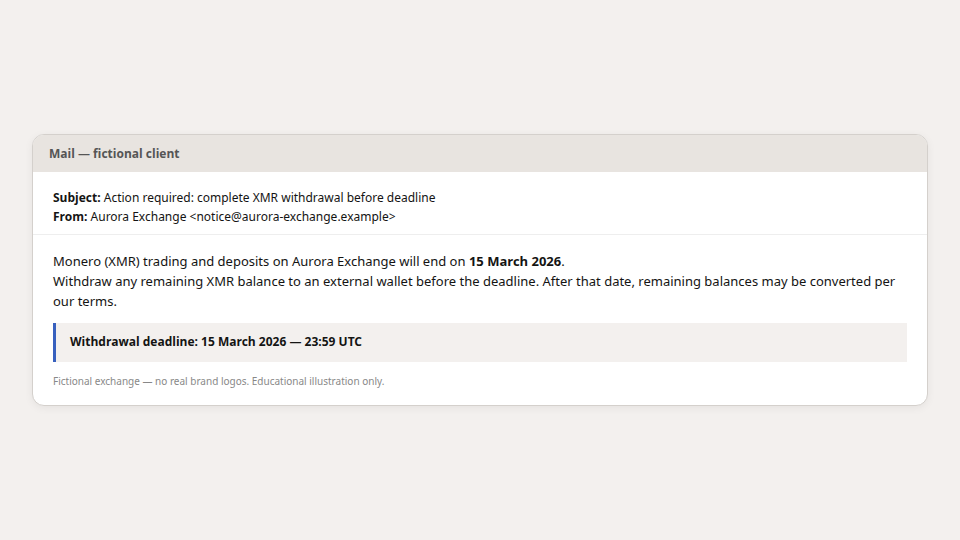
You do not need to speculate about forced exits. Kraken published a documented EEA Monero wind-down:
| Milestone | Date (Kraken support article) |
|---|---|
| Trading + deposits halted | 31 Oct 2024 15:00 UTC |
| Withdrawals allowed until | 31 Dec 2024 15:00 UTC |
| Remaining balances converted to BTC at market rate | Distribution by 6 Jan 2025 |
That episode predates the July 2027 AMLR application date. It shows what “ban the exit” feels like in product terms:
- Trading stops.
- Withdrawal window.
- Forced conversion if you miss the window.
Tax and record-keeping consequences can follow forced conversion — see CEX to self-custody opinion with disclaimer.
Why demand rerouted instead of dying
Sector reporting in 2025–2026 noted a paradox: dozens of exchanges delisted privacy coins while XMR market activity rerouted to instant swaps, DEX-style venues, atomic swaps, and P2P channels outside listing committees.
AMLR Article 79 accelerates that rerouting inside the EU — it does not, in public legal summaries, criminalize self-custody.
Archive’s editorial read: regulators are comfortable closing intermediated exits first. That is why where to buy when exchanges delist exists as a living post, not a historical footnote.
Digital euro timing — opinion, not prophecy
Critics note the July 2027 AMLR application sits near mid-2027 digital euro testing windows and €1,000 crypto transfer identification thresholds in the same regulatory package. Archive records the sequence as a citeable calendar fact; it does not claim motive.
Readers who care about non-custodial options should watch exit infrastructure, not Twitter ideology threads.
Disclaimer
This article is editorial opinion and general information, not legal or tax advice. Rules vary by country; consult qualified counsel for your situation.
Practical checklist before July 2027
| Question | Why ask it |
|---|---|
| Where is my XMR sitting? | Exchange IOU vs keys you control |
| What is the published delist date? | Venues move 6–12 months before statutes |
| What happens to unwithdrawn balances? | Forced conversion terms |
| What is my non-CEX path? | Instant swap vs P2P |
| Do I have records for tax reporting? | Delist ≠ delete tax obligation |
Terms in this article
| Term | Meaning here |
|---|---|
| AMLR | EU Anti-Money Laundering Regulation (2024/1624) |
| Article 79 | Anonymous accounts + anonymity-enhancing coins prohibition for obliged entities |
| CASP | Crypto-asset service provider |
| Forced conversion | Venue sells your balance after a deadline |
| Self-custody | Keys outside exchange IOU |
| Anonymity-enhancing coin | Asset designed to obscure transaction metadata (regulatory wording) |
FAQ
Can I still own Monero in the EU after July 2027?
Public legal summaries say holding in self-custody is not what Article 79 prohibits. Regulated platform services for XMR are.
Will every EU exchange wait until July 2027?
Unlikely. Historical pattern is early delists (Kraken 2024, others 2024–2026).
Does Domestic Monero “solve” AMLR?
No. It is a P2P offer product on Telegram — not a licensed EU CASP. Different perimeter: Haveno vs Telegram Mini App.
Official entry?
@domestic_monero_bot.
Next steps
- Read your exchange’s withdrawal notice — not the headline.
- Move bearer assets to self-custody before forced conversion windows.
- Map post-CEX routes via delisting tracker.
Related: EU headline said banned · MiCA register check · Form 1099-DA broker edge