DAC8 and CARF from 2026 — what EU crypto platforms must report

DAC8 — the EU’s eighth amendment to the Directive on Administrative Cooperation (Directive (EU) 2023/2226) — extends automatic tax-information exchange to crypto-asset transactions. It implements the OECD Crypto-Asset Reporting Framework (CARF) inside the EU.
Reporting Crypto-Asset Service Providers (RCASPs) began collecting reportable data on 1 January 2026. The first calendar reporting year is 2026; EU tax authorities are scheduled to exchange information on non-resident users by 30 September 2027.
This is a transparency regime for regulated intermediaries — not a ban on self-custody or peer-to-peer software.
At a glance
| Field | Value |
|---|---|
| Topic | DAC8 / CARF; RCASP reporting; 2026 collection; 2027 exchange |
| Format | Regulatory timeline + scope table |
| Collection start | 1 January 2026 |
| First EU cross-border exchange | By 30 September 2027 (2026 reporting year) |
| Product mentioned | Domestic Monero — Telegram Mini App for P2P Monero trades |
| Official entry | @domestic_monero_bot |
| Support | /support on the official bot only (include Trade #ref + trade state) |
| Assets (P2P) | XMR ↔ BTC, LTC, ETH, SOL, USDT (ERC-20) |
| What it is not | Tax evasion guidance; a promise CARF covers every wallet; on-chain Monero multisig |
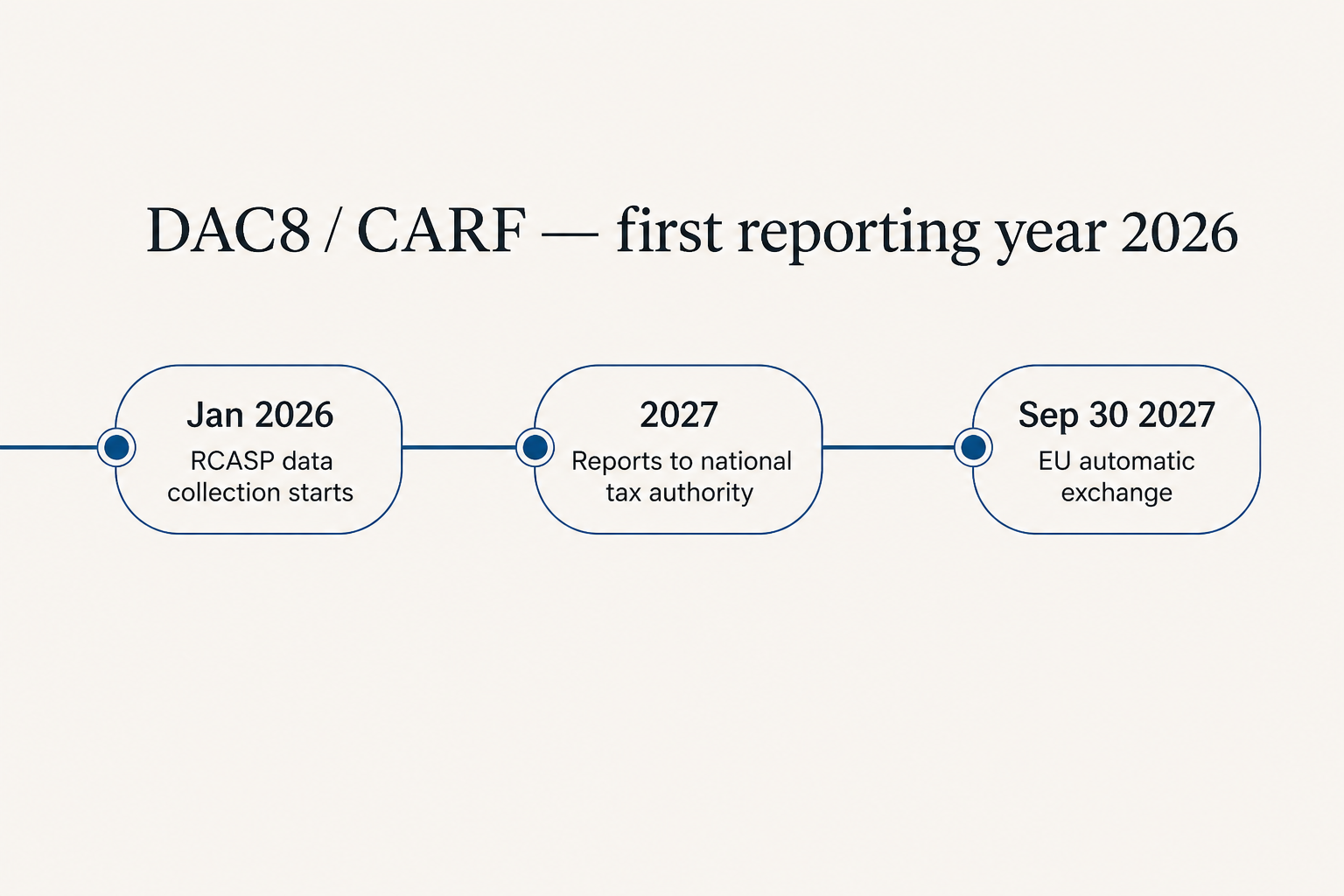
Timeline (official EU framing)
| Date | Event |
|---|---|
| 17 October 2023 | DAC8 adopted; published in Official Journal |
| 31 December 2025 | Member States’ transposition deadline |
| 1 January 2026 | RCASPs begin collecting reportable transaction data |
| 2027 (national deadlines vary) | RCASPs file reports to home tax authority |
| 30 September 2027 | EU automatic exchange for 2026 reporting year |
Source: European Commission — DAC8.
Member States set domestic filing formats and exact deadlines inside the EU framework. Netherlands Tax Administration cites a 31 January 2027 RCASP filing example — check your provider’s jurisdiction.
What RCASPs must collect
DAC8 targets Reporting Crypto-Asset Service Providers — MiCA-authorised CASPs and certain other crypto service providers meeting the directive’s scope.
| Data class | Examples |
|---|---|
| User identity | Name, address, tax identification number (TIN), residence |
| Transaction facts | Reportable crypto-asset transactions — purchases, sales, transfers per CARF/DAC8 scope |
| Cross-border logic | Home authority receives data; exchanges with user’s country of residence |
CARF also rolls out globally on staggered schedules — 46 first-wave jurisdictions exchanging by 2027, including the UK, Japan, and Brazil alongside EU DAC8.
What DAC8 does not automatically cover
| Activity | Typical DAC8/CARF posture |
|---|---|
| Self-custody wallet (keys only you hold) | Not an RCASP report — no platform filing your trades |
| Pure P2P without a reportable service provider | Outside RCASP reporting pipe — tax law still applies |
| Monero chain privacy | Does not erase legal duty to report income where your jurisdiction requires it |
| Domestic Monero Telegram P2P | Product is not a MiCA CASP; users remain responsible for local tax compliance |
Read this as information perimeter design, not “privacy vs law.” Exchanges and custodial apps become more reporting-transparent; self-custody and P2P shift record-keeping burden to you.
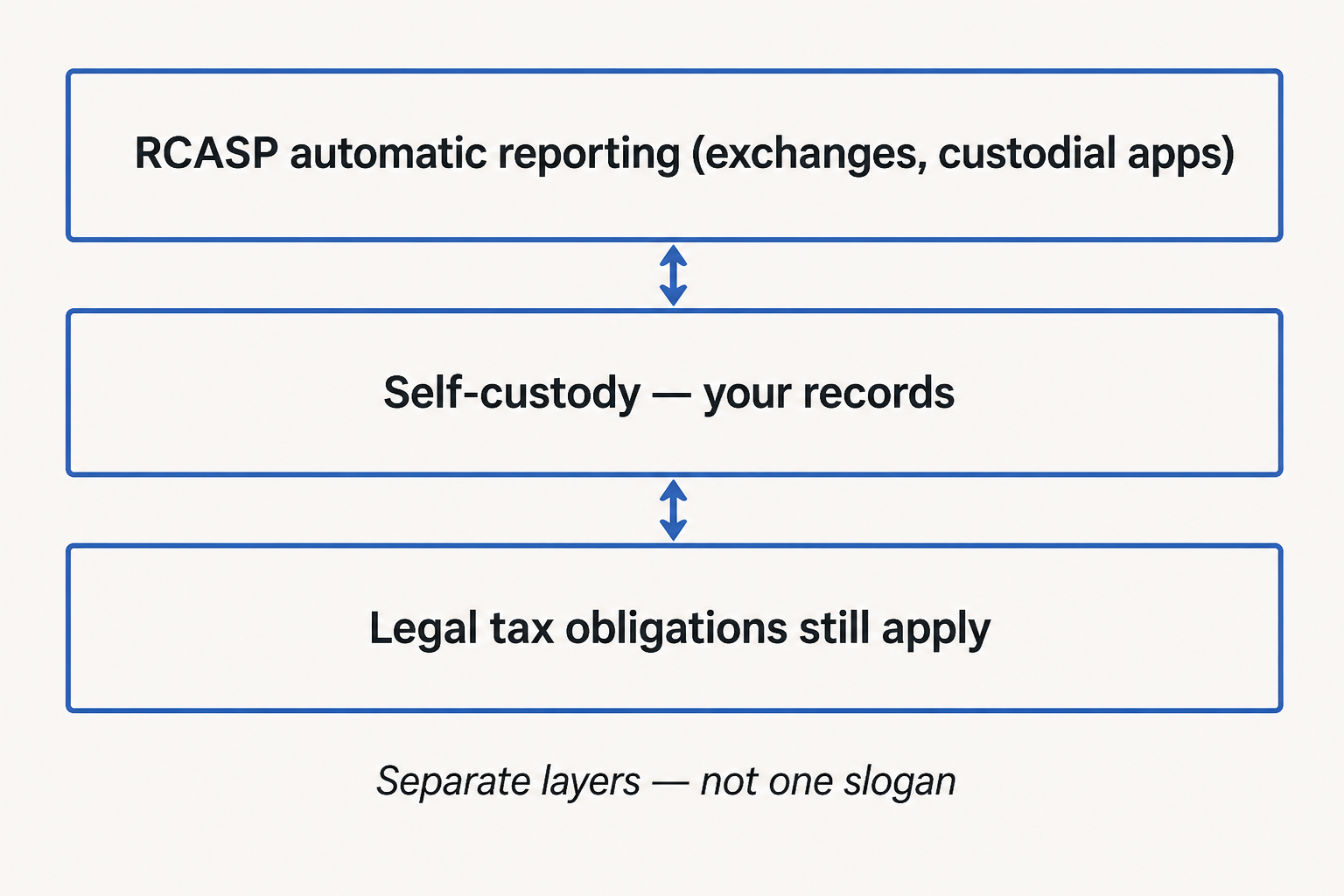
How DAC8 stacks with other EU crypto rules
| Rule | Job | Status (2026) |
|---|---|---|
| MiCA | CASP authorisation, conduct | Licensing transition largely complete mid-2026 |
| TFR / Travel Rule | Transfer identity data between CASPs | Live since 30 Dec 2024 — Travel Rule explainer |
| AMLR Art. 79 | Ban CASP custody of anonymity-enhancing coins | Applies 10 July 2027 |
| DAC8 / CARF | Tax reporting and automatic exchange | Collection 2026; exchange 2027 |
Together they shrink the regulated middle for privacy assets while leaving self-custody and P2P as discussed legal categories — not anonymous immunity.
Practical tips (compliance-minded, not evasion)
- Export exchange history now — Before 2026 trades disappear behind new reporting UX, download CSVs where venues allow.
- Track cost basis off-platform — If you move BTC/USDT → XMR via P2P, your records become the audit trail.
- Separate stablecoin float from long-term XMR — Issuer reporting and CASP reporting both increase paper trails on custodial dollars.
- Use official P2P only — Scam DMs do not help privacy; they steal funds. @domestic_monero_bot only.
- Consult a tax professional locally — Archive explains product facts; it does not file your return.
Stablecoin issuer freeze plane (separate law): GENIUS / stablecoin freeze explainer.
Why Monero users watch DAC8
| Concern | Reality check |
|---|---|
| “EU will see every Monero tx” | CARF targets RCASP-reported events, not automatic full-chain surveillance of self-custody |
| “P2P is invisible to tax authorities” | False comfort — legal obligations may still require reporting gains; privacy ≠ invisibility in court |
| “I should leave custodial venues” | Many users accelerate self-custody as reporting expands — operational choice, not legal advice |
Domestic Monero offers XMR ↔ BTC, LTC, ETH, SOL, USDT (ERC-20) peer trades in Telegram with staged states and /support. It fits users who already decided to operate off the CASP book — with eyes open about local law.
Conversion guide: BTC or USDT → XMR without an exchange account.
Terms in this article
| Term | Meaning here |
|---|---|
| DAC8 | EU Directive (EU) 2023/2226 — crypto tax reporting and exchange |
| CARF | OECD Crypto-Asset Reporting Framework — global reporting standard |
| RCASP | Reporting Crypto-Asset Service Provider — files DAC8/CARF reports |
| CASP | Crypto-asset service provider under MiCA |
| Automatic exchange | Tax authorities swap RCASP data across borders on schedule |
FAQ
When did DAC8 collection start?
1 January 2026 for reportable crypto-asset transactions at in-scope providers.
When will EU countries share data?
First exchanges for the 2026 reporting year are due by 30 September 2027 per Commission guidance.
Does DAC8 ban Monero?
No. It expands tax reporting for in-scope providers. AMLR Art. 79 (2027) is the separate CASP custody prohibition for anonymity-enhancing coins.
Does Domestic Monero report to tax authorities?
Archive public copy describes a Telegram P2P product, not a MiCA CASP. Users remain responsible for their own tax compliance.
Is P2P trading tax-free?
No universal rule. DAC8 does not replace national tax law on capital gains or income.
Next steps
- Download custodial history from any exchange you still use.
- Read EU Travel Rule and EU 2027 AMLR as separate layers.
- Verify bot handles before trading: Verify official channels.
Marketing site: domesticmonero.com.
Related: EU Travel Rule zero threshold · Self-custody habits · BTC/USDT → XMR without exchange