Two Brazil central bank rules landed in August — different clocks

Brazil published two separate central-bank rules in 2026 that change how value leaves — or settles across — supervised financial rails. They are easy to merge into one headline (“Brazil tightened crypto”). They are not the same mechanism, date, or corridor.
This explainer keeps them apart: Resolução BCB nº 584 (published 7 August 2026) on precautionary holds at virtual-asset providers, and Resolução BCB nº 561 (published May 2026) on electronic FX (eFX) cross-border settlement.
At a glance
| Field | Value |
|---|---|
| Topic | Brazil BCB Res. 584 (24h hold) + Res. 561 (eFX stablecoin leg) |
| Format | Dual-rule regulatory explainer — no evasion guide |
| Res. 584 effective | 1 January 2027 |
| Res. 561 effective | 1 October 2026 |
| Product mentioned | Domestic Monero — Telegram Mini App for P2P Monero trades |
| Official entry | @domestic_monero_bot |
| Support | /support on the official bot only (include Trade #ref + trade state) |
| Assets (P2P) | XMR ↔ BTC, LTC, ETH, SOL, USDT (ERC-20) |
| What it is not | Legal advice; a Brazil ownership ban; on-chain Monero multisig |
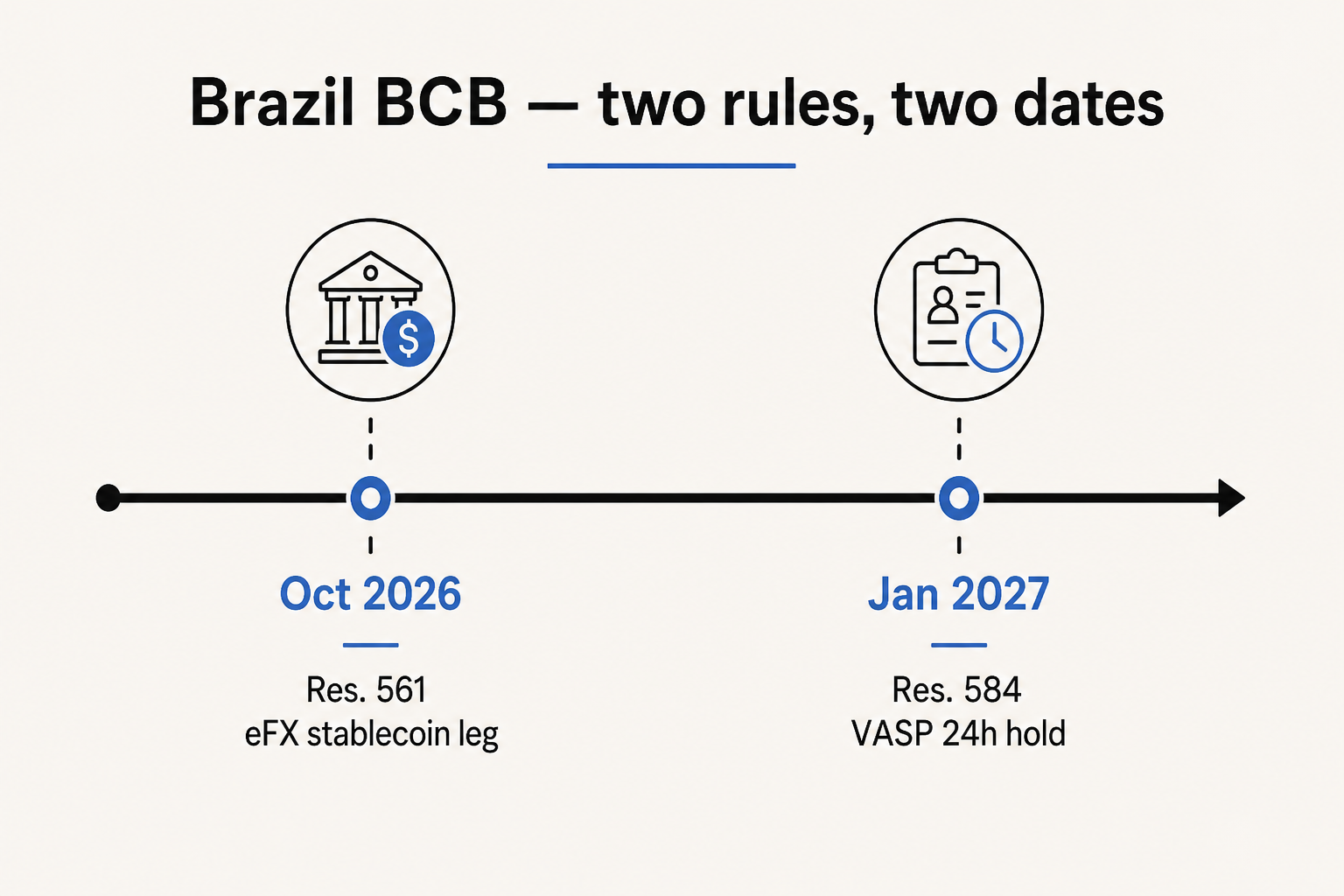
Rule 1 — Resolução 584: the 24-hour hold (Jan 2027)
On 7 August 2026 the Banco Central do Brasil (BCB) published Resolução BCB nº 584, amending the fraud-prevention framework in Resolução 142/2021. New article 2º-B requires authorised virtual-asset service providers (PSAVs / VASPs) to apply a precautionary hold of up to 24 hours on qualifying outbound transfers.
| Trigger | Scope |
|---|---|
| Amount | Above US$10,000 per transfer or same-day cumulative total |
| Destination | Self-custody wallet or a foreign virtual-asset firm |
| Start date | 1 January 2027 |
Public commentary frames the hold as a fraud-prevention window, not an indefinite freeze. Providers may release earlier if internal risk review clears the transfer — but the default posture is next-day exit, not instant withdrawal.
Brazil is a large crypto market with heavy stablecoin use in payroll and remittance-style flows. Supervisors are aligning crypto exits with bank-wire delay logic: large outbound value gets a review beat before it leaves a supervised intermediary.
Separate operational deadline: many sector reports cite 30 October 2026 as the practical cutoff for Brazilian VASPs to hold BCB authorisation (or an application in progress) to keep serving the market. That licensing clock is not the same as the 24-hour hold start date.
Rule 2 — Resolução 561: stablecoins out of eFX settlement (Oct 2026)
Resolução BCB nº 561 targets a narrow channel: eFX — Brazil’s simplified electronic FX route for retail digital cross-border flows (international card purchases, digital remittances through payment institutions and acquirers).
| What changes | Detail |
|---|---|
| Channel | Settlement between an eFX provider and its overseas counterparty |
| Banned leg | Stablecoins and other virtual assets as the settlement instrument |
| Required leg | Traditional FX operations or non-resident BRL accounts |
| Effective | 1 October 2026 |
What 561 does not do: ban all stablecoin cross-border activity in Brazil. Licensed SPSAVs operating under the FX-market regime (Resolução 521) may still use stablecoins on their supervised perimeter — with reporting and counterparty obligations. The rule removes stablecoins from one retail eFX settlement pipe, not from the entire economy.
Cross-link (different law): DAC8 / CARF global reporting mentions Brazil in CARF’s first-wave exchange list — tax transparency is a third layer from these two BCB operational rules.
Side-by-side — do not merge the columns
| Res. 584 (hold) | Res. 561 (eFX) | |
|---|---|---|
| Problem framed | Fraud / suspicious outbound PSAV transfers | Retail cross-border settlement plumbing |
| Who feels it first | Customer exiting a Brazilian VASP to self-custody or foreign platform | eFX payment institutions and their cross-border settlement |
| Date | 1 Jan 2027 | 1 Oct 2026 |
| Stablecoin angle | Any qualifying virtual-asset transfer above threshold | Stablecoin leg removed from eFX settlement only |
| Self-custody | Still legal — large supervised exits may slow | Unaffected directly — different rail |
Why Monero/P2P readers notice Brazil
Exchange delistings and regional CASP rules already push privacy-coin users toward off-book acquisition. Brazil’s 2026 package adds timing friction on supervised exits (584) and rail redesign on one remittance settlement channel (561).
That is not the same as outlawing self-custody or peer software. It does change the math on “deposit reais → buy USDT → withdraw tonight to your wallet” workflows that relied on instant supervised exits.
Peer Monero paths — including Telegram P2P offers — sit outside the BCB VASP hold table, but local law, tax, and payment proof still apply. See buy Monero without KYC — what it means for product-language bounds.
Terms in this article
| Term | Meaning here |
|---|---|
| BCB | Banco Central do Brasil — Brazil’s central bank |
| PSAV / VASP | Virtual-asset service provider under Brazilian supervision |
| eFX | Simplified electronic FX channel for retail cross-border digital flows |
| Precautionary hold | Up to 24h delay before release — fraud-prevention window |
| Self-custody wallet | Wallet whose keys you control — not a provider custody account |
FAQ
Are these the same rule?
No. 584 = VASP outbound hold from Jan 2027. 561 = eFX stablecoin settlement ban from Oct 2026.
Does 584 ban self-custody?
No. It slows large supervised exits to self-custody or foreign platforms.
Does 561 ban USDT in Brazil?
No. It removes stablecoins from eFX settlement between providers — not every licensed stablecoin corridor.
Does Domestic Monero operate as a Brazilian VASP?
Public copy describes a Telegram P2P product, not a BCB-authorised PSAV. Users remain responsible for local compliance.
Where is Western Union’s stablecoin card in this picture?
Different product layer — see Western Union Stablecard explainer (KYC remittance rail, not BCB eFX settlement detail).
Next steps
- If you use Brazilian on-ramps, map Oct 2026 eFX vs Jan 2027 hold dates on your own calendar.
- Compare supervised exit delay vs peer segments: BTC/USDT → XMR without exchange.
- Verify bot handles: Verify official channels.
Marketing site: domesticmonero.com.
Related: DAC8 / CARF reporting · Stablecoin issuer freeze plane · Where to buy when exchanges delist